MOVIE NIGHT

Georgina Young-Ellis, author of The Time Baroness, has gone to the movies to review all those must-see films for women.
Catch her latest new release film and DVD guide every second Friday.

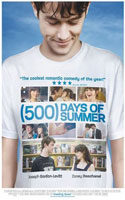
(500) DAYS OF SUMMER (2009)


This is a film that gets better the more you watch it; you pick up more humour, notice more subtleties, and absorb more of the cinematic quirkiness that makes this movie so much better than the typical romantic comedy. It stars Zooey Deschanel as Summer Finn, an irresistible girl whose unwillingness to commit makes her all the more attractive to the hapless Tom Hansen, played by Joseph Gordon-Levitt. Both of these actors have that offbeat, indie appeal that makes one hope they'll keep away from the mainstream movies a while longer. (Zooey is the sister of Emily Deschanel, who stars in the American TV series Bones.) The movie jumps around in time, beginning from day 488 of Tom and Summer's relationship, immediately back to day one and everywhere in between. The popping back and forth gives the viewer not only a foreshadowing of what Tom is in for, but makes him seem just a little unstable as his moods swing from elated in the early days, to despondent in the later, not in any particular order. Just like him, we don't know whether to love Summer or hate her. Is she realistic in her view that love doesn't exist or is she in denial? Of course we want to root for love, but this story takes us down a slightly different road, one that doesn't rely on the same old boy meets girl conventions. This is no fairytale; rather a tale that reminds us that love will find us when we're ready, and that we might be happier without the Hollywood ending.

We don't know whether to love Summer or hate her. Is she realistic in her view that love doesn't exist or is she in denial?
The cast is full of familiar faces, characters in Tom's life who try to keep him from getting his heart handed to him on a platter. Deschanel is enchanting in the lead role, and men love this film because of her - making it a romantic comedy that's not actually geared towards women. The story is told from a man's point of view and many men will relate to Tom's experience. But women love it too because it's a great story, very funny and very poignant. (Oh, and Gordon-Levitt is adorable.) It is also very cleverly edited. In one scene Tom is elated because he has just spent his first night with Summer. As he's walking down the street to the beat of a snappy tune playing in his head, every stranger he passes gives him a high five or a pat on the back. They fall into step and perform a choreographed dance number together. A marching band chimes in, and a little animated bluebird comes to sit on Tom's hand. It's director Marc Webb's over-the-top way of showing us that Tom is feelin' really good. He steps into the office elevator, big grin on his face; the date snaps forward several months, and the elevator door opens on a Tom that is now (hilariously) a physical and emotional disaster.
Another brilliant piece of editing shines in a scene where Tom goes to a party that Summer has invited him to. The screen splits. On one side the word "reality," is displayed, and on the other, "expectation". The two scenes play out simultaneously - one showing what really happens, while the other shows Tom's fantasy of what he hopes will happen. It's subtle but sensational comedy. The laughs come one after another in this film but none are cheap. This is not what you'd call a feel-good movie but the feeling it leaves you with is very, very nice.


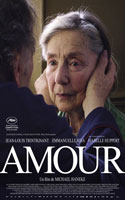
AMOUR (2012)


Don't let the title fool you; Amour is about as far from a romance as you can get, though it is about two people who love each other. It deals with an elderly woman who has a series of strokes, and her husband who cares for her as she drastically deteriorates. It's gruelling, it's hard to watch, it's unpleasant. There is literally nothing at all pleasant about it. It doesn't fill you with a warm feeling of sweetness at how much the husband sacrifices for his wife, because it's really hard on him and he seems quite miserable. Of course, that's the point. Sacrifice is sacrifice, one doesn't usually enjoy it. But Amour is so very hard to watch, in spite of the fact that Emmanuelle Riva was nominated for an Academy Award for her role as Anne, the stroke victim, and the film was nominated for Best Picture, Best Director and Best Screenplay and won for Best Foreign Film.

While the host leaves the room to get the tea, the audience endures, in real time, the person just sitting in the room waiting for the tea.
It astounds me that anyone thought the film was worthy of any of those awards, except, perhaps, Riva's nomination, because, completely divorced from the fact that it's tragic and uncomfortable, it's very slow ... excruciatingly so. What director films a scene in which a person is offered a cup of tea, and then, while the host leaves the room to get the tea, the audience endures, in real time, the person just sitting in the room waiting for the tea - doing absolutely nothing for the full three minutes or so that it takes for the host to make the beverage? Three minutes of nothing on film is a very long time. And finally, the ending is incredibly confusing - or at least it was for me. I didn't even know if it was happy or sad, I only know that my husband and I suffered through the whole thing waiting for redemption of some kind - a resolution that never came. Please, don't think that I don't admire and feel for the people who are caretakers, whether by choice or not, of very sick or disabled people, giving up their own lives out of love, or lack of money, or because it's their job. I may even find myself in the position of being a caretaker one day, and know many people who have done it. And of course any of us could end up being the person who needs to be cared for in dire circumstances. All of it is difficult, wrenching, and depressing, I get it. But I don't watch movies to be left with a sense of complete hopelessness. I watch them, not only to be entertained, but to be moved, to learn something, to be changed. I got none of that from Amour. Watch it at the risk of enduring a very sad, and very long, two hours.


BEGINNERS (2010)


Beginners is a film I really wanted to like. Starring Christopher Plummer, one of my all-time favorite actors, as a dying man named Hal Fields who has finally come out as gay in his old age, (a role that won him an Academy Award) I had high hopes. Another of my faves, Ewan McGregor, plays Hal's son, Oliver. Though Beginners mostly came through for me, there were areas where I found it lacking.

If you don't see it for any other reason though, see it for Christopher Plummer's performance: one of the few happy spots in this otherwise downbeat film.
The story centres around Oliver, who, after his mom dies, and he finds out about his father's prognosis, embraces sadness like a teddy bear. He uses it in his work as an artist, and wears it on his sleeve while he tentatively begins a relationship with a French actress, Anna, played by Melanie Laurent. Her moods match his so precisely they can almost not stand to be together - yet neither can they stand to be apart. However, Hal is so determined to find joy in the time he has left, to have a boyfriend, to participate in gay pride, to have parties and go to clubs, that it makes his son's morose outlook seem self-indulgent.

The story jumps back and forth in time so that sometimes the action takes place after Hal's death, sometimes before, and sometimes as far back as Oliver's childhood wherein he shares a close, if not somewhat quirky relationship with his mother, Georgia. Played by Mary Page Keller, Georgia is a woman who long ago accepted she married a gay man but still yearns for his attentions. She pours her frustrated energies into raising her son, creating a sweet and enduring relationship with him, which is why Oliver is so lost after her death. He ultimately begins to truly understand his parents' relationship through the truths that Hal reveals to him. The non-linear story is helped along by the use of Oliver's illustrations and musings, which serve to narrate the film to some degree. This same kind of mixed-media effect, along with a well-edited time line, reminded me of a film I loved, 500 Days of Summer. But though Beginners isn't meant to be a romantic comedy, as 500 Days of Summer sort of is, all the clever effects and editing don't really serve to scrape this movie out of the doldrums. It's a well-written, well-directed, well-acted film, but I just can't say I loved it. Some sad movies serve as cathartic - helping us get through the tough times in life. Others just make us depressed. Beginners falls somewhere in between. If you don't see it for any other reason though, see it for Plummer's performance: one of the few happy spots in this otherwise downbeat film.


BRIDESMAIDS (2011)


Bridesmaids is a very funny but not entirely well-made movie. We see from the opening scene that it's going to be crude ? that's OK, we've been prepared by the hype and the trailers. Essentially, it's a movie made for women who appreciate gross-out, sexual or scatological humour and/or for their boyfriends. It's a film for the generation who grew up with South Park and Family Guy and maybe even for their mums who watched (and perhaps still watch) Saturday Night Live. Even in my old age I enjoy fairly sick humour, and certainly a good laugh from similar films such as The 40 Year Old Virgin and The Hangover. I definitely laughed good and hard during Bridesmaids; so hard, as a matter of fact, over the poop humour, that long after my teenage son had stopped, I was still struggling to control myself while tears streamed down my face. This is not your average rom-com/chick flick.

The actresses are all exceptional. Maya Rudolph has terrific comic chemistry with Kristen Wiig, left over, no doubt, from their Saturday Night Live connection.
So, the film is funny. Now for the problems. The story is a little slow at first, and some characters not sufficiently developed. There's not a resolution to every situation and director Paul Feig tries so hard to wrap up the ending quickly, that certain details get overlooked. For example, (I don't think this qualifies as a spoiler) the bride, Lillian, played by comedienne Maya Rudolph, appears before her friend Annie, played by Kristen Wiig (also co-screenwriter, in a ridiculously poufy, couture wedding gown designed in France. Annie, who, as far as we know, is not a skilled seamstress, assures her friend she can fix it, and Lillian shows up in the next scene in the altered dress. How did this miracle occur? There's no explanation. And here's a small detail that I may be considered picky for pointing out, but to me is a symptom the director's overall lack of attention to detail: Annie, a down-and-out woman with continually diminishing resources and luck, always seems to have the same, perfect red manicure, week after week. And it's not like she's particularly a girly-girl. This kind of thing distracts me and makes me feel like the director, or someone, is being sloppy.

On the up side, the actresses are all exceptional. Rudolph has terrific comic chemistry with Wiig, left over, no doubt, from their Saturday Night Live connection. Melissa McCarthy, as oversized bridesmaid Megan, is so outrageous it makes me wonder why this delightful actress has been relegated to the terrible American sitcom, Mike and Molly. Who knew she was such a comedic gem? Fellow bridesmaids Wendi McLendon-Cove as raunchy, burnt-out mum Rita, and Ellie Kemper as her dumb, doe-eyed protege Becca, round off the main cast splendidly. Another standout is Annie's competition for maid of honour, Helen, played by Rose Byrne, who recently appeared as Russell Brand's love interest in Get Him to the Greek. She is perfectly suited for this kind of comedy, able to flawlessly pull off the sweet innocent act that hides the bad girl lurking inside. It is refreshing that this is a cast of not-beautiful (though not-unattractive) women, who have obviously not succumbed to Hollywood's expectation of cosmetic surgery and implants. They look how they look, flaws and all, and it makes us, as the audience, relate and connect. Finally, I did suspect that Maya Rudolph was pregnant, which is fine, but they seemed to be trying to cover it up and I wondered why. Who cares if the bride is pregnant? But in spite of the flaws, Bridesmaids is tons of fun. Be sure not to miss it.


BRIDGET JONES'S DIARY (2001)


Hearkening back to the book that, in my opinion, started the whole chick lit movement, I'm always surprised when I find someone who doesn't know that Bridget Jones's Diary was based on Pride and Prejudice. A great modern take on a classic, the movie version of Bridget Jones's Diary is nearly as good as the Helen Fielding book. There was some criticism at the time that American actress Renee Zellweger was chosen to play this quintessentially British character. But she does it with such a charming combination of vulnerability and klutziness that the world fell in love with her Bridget, and, to my American ear, she nailed the British accent.

We ultimately see that Darcy has been wronged by Cleaver/Wickham. This is when we begin to see him in a different light. As his goodness is revealed, his sex appeal emerges.
Of course, Bridget is the alter-ego of Elizabeth Bennett complete with ridiculous mother and sympathetic father, though without the four sisters. Daniel Cleaver, played by Hugh Grant, is based on Mr Wickham. When I read Pride and Prejudice for the first time, it wasn't immediately obvious to me that Wickham was a cad, but sexy and charming Grant-as-Cleaver leaves us no doubt that this is going to be a bad choice for Bridget. Colin Firth plays Mark Darcy, a spectacularly funny choice on the part of director Sharon Maguire, since he also played Mr Darcy in the BBC version of Pride and Prejudice. (Supposedly, Helen Fielding had Firth in mind when she was writing the book.) However, Maguire understood that Mark Darcy should not be appealing at first, and, just as in P&P, he seems stuffy and priggish at the party where Bridget encounters him. No amount of Austen describing Darcy as tall and handsome makes him seem like he could interest Elizabeth, just as Mark Darcy does not in the least appeal to Bridget.

The plot proceeds similarly in both P&P and in Bridget Jones's Diary, and we ultimately see that Darcy has been wronged by Cleaver/Wickham. This is when we begin to see him in a different light. As his goodness is revealed, his sex appeal emerges. When Bridget/Elizabeth and Darcy/Darcy finally come together at the end of both stories, we are swept away by the romance of it. In the Bridget Jones movie, it is Christmastime, it's snowing, and Darcy stands there telling Bridget that he's come back from America because he forgot to kiss her. I remember the moment when I first saw it in the cinema with my best friend, both of us in an absolute puddle. It's the same feeling I had at the end of Pride and Prejudice when Darcy tells Elizabeth, "If your feelings are still what they were last April, tell me so at once. My affections and wishes are unchanged, but one word from you will silence me on this subject forever." Austen goes on to describe how Elizabeth then ensures him that her feelings have changed, that she, now, belongs to him. There is then a satisfying denouement that we don't get in the film version of Bridget Jones's Diary; however, the moment in the snow is luscious enough. Though some people did not appreciate Fielding ravaging the great classic for her chick lit romp, and others think the film version of Bridget Jones didn't hold up to the book, in this love triangle of film and literature I think all three ended up winning. If anyone could possibly do Pride and Prejudice justice, it's Fielding, and if anyone could do Fielding's book justice, Sharon Maguire did.


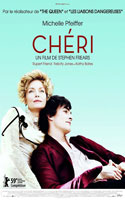
CHERI (2009)


Cheri, the period piece directed by Stephen Frears, satisfies on so many levels. It is art film, romance, drama and even comedy, with stars such as Michelle Pfeiffer, Kathy Bates and Rupert Friend lending it sparkle. Pfeiffer turns in one of her best performances ever as an aging, French courtesan during the Belle Epoque (early 1900s). Her character, Lea de Lonval, has a long-term affair with her best friend's beautiful son, Fred (Friend), whom she has called Cheri since he was a little boy. He is a rather indolent, spoiled, young man, pampered by the two maternal figures in his life. He's a bit of a fop: adoring fine clothes, jewellery and all of the finer things in life. He doesn't mind being kept by Lea (whom he has always called Nunu) and she doesn't mind keeping him. But their relationship is more than cougar and gigolo. Much more. They truly and deeply love each other, though neither freely admits it, for the dalliance they enjoy is more delicious than a conventional relationship. After Cheri and Lea have lived together for several years, his mother, Madame Peloux, decides he must marry a rich young woman and he reluctantly goes along - with Lea's condescension - at least outwardly. Yet the pain that each feels over their separation is a palpable, exquisite longing. The film is an expression of all that is beautiful about the Belle Epoque: literally, "The Beautiful Era."

They truly and deeply love each other, though neither freely admits it, for the dalliance they enjoy is more delicious than a conventional relationship.
Frears is obviously in love with the time period. Every shot is in itself a masterpiece, exhibiting and exalting the architecture, furniture, clothing, jewellery and design that represent the hallmark style of the period, Art Nouveau. The visual delights never stop. The scenery, lighting and of course the lovely Ms Pfeiffer, even at her "advanced" age of forty-something, are wondrous. However, as this is a film made largely to appeal to women, its centerpiece is the gorgeous Friend, often scantily clad, who lounges about in deliberate poses that set off his pale, slim, youthful body and chiselled face to ultimate effect. There's even a moment when we enjoy an excellent butt shot of him exiting the boudoir.
Frears understands women. He also understands actors. Though set in France, the American and British actors use their own accents with upper class intonation, and it all works. No one is trying to pretend a French accent just because they're supposed to be French. Bates is hysterically funny - and somewhat frightening - as the overbearing, money-hungry, gossip mongering Madame Peloux; and all her ridiculous cohorts add the perfect note of satire. Friend flawlessly embodies the idea of boy-toy, torn though his character is between his love for Lea and his duty to the wealth he maintains by feigning interest in his innocent, young wife. There are no promises of a happy ending here, merely an ending that fits. The story, written by the notorious author of erotica, Colette, is masterfully crafted. And though most books are better than their film counterparts, it's hard to imagine a read more satisfying than this sensual work of art.


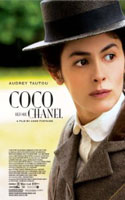
COCO BEFORE CHANEL (2009)


There is an expectation from a film with the word Chanel in it that it's going to be all about fashion. Coco Before Chanel, surprisingly, is not. As the name implies, it is about the life of the woman before the Chanel empire existed. The film never even informs us that Chanel was her last name; however, we do learn how the orphan named Gabrielle became nicknamed Coco - it was from a song she sang, when she was a cabaret singer, about a little dog. Pretty humble beginnings for the queen of fashion. She was a scrappy and practical survivor in her youth, a person who would not have succumbed to the frilly excesses of pre-World War I fashion even if she'd had the money. Though not exactly a prostitute, the film implies that she did trade sex for a roof over her head with an upper-class boor who exploited her. Yet he also introduced her into his world, giving her the connections she needed to obtain independence.

The sensitive performances, the lovingly designed sets and beautiful scenery really let us experience the world of Coco.
The film has three acts: Coco's early struggle, the flourishing of her creative vision, which happens simultaneously as a great romance, and ultimately, her establishment in the world of fashion. The final act is all too short for those for those who hope to glimpse more of the iconic clothes she created from the 1920s until the day she died in 1971, but it is nevertheless incredibly interesting to witness the birth of those inspirations. Actress Audrey Tautou, who plays Coco, lets us look directly into the soul of the woman, while director Anne Fontaine literally directs our eyes to see what Coco saw: the images that influenced her designs. It is a gorgeous film - every frame thoughtfully captured - many of them masterpieces in their own right. The sensitive performances, the lovingly designed sets and beautiful scenery really let us experience the world of Coco. And as final reward, we are treated to a Chanel fashion show, circa, perhaps 1950. This last scene of the film will take your breath away.
The movie is in French with subtitles, but even this, which can be a hurdle for some viewers, simply serves to immerse us in Coco's universe. We may not come away thinking it was a very pleasant one, but Coco Before Chanel causes us to realise that the fashion industry would have gone in a very different direction if circumstances had been different for this remarkable woman.


CRAZY, STUPID, LOVE (2011)


It's been a long time since I've seen a movie so good I could not find any flaws in it; or enjoyed a film so touching and entertaining I wasn't even aware of time passing as I sat in the theatre. Such was my experience with Crazy, Stupid, Love. It is the story of Cal and Emily who, on their way to divorce, are both searching for a more exciting love life than the one they left. It is also the story of Jacob, a shallow but attractive young man who takes it upon himself to transform sad sack Cal, played by Steve Carell, and make him desirable to the opposite sex. And it's about Hannah, a smart young woman looking for a guy that's worthy of her. Not least of all, it is about Cal's and Emily's son Robbie, played by Jonah Bobo, (tiny spoiler alert) who is in love with his babysitter Jessica, played by Analeigh Tipton, who is in love with Cal.

It is also a movie about redemption, and fighting for the person you love against all odds.
It is an aptly named piece of cinema because it illustrates so precisely how love makes everyone behave stupidly and crazily at some point in their lives. It is also a movie about redemption, and fighting for the person you love against all odds. This final point is one reason Crazy, Stupid, Love touched me so deeply. In some ways, it was very personal to me, a very near reflection of a story that was once mine. But whether you're middle-aged and married, or young and just starting down the road to commitment, it will speak to you. I would almost say it is also a film for the very young, such as Robbie's age of 13, or Jessica's of 17, because it truly portrays the pain of being in love for the first time and not having the object of your affection return those feelings. But I would say it is mostly a movie for people who have been there - who have experienced the heartbreaks and joy of true love. It is a surprising and original story with dialogue that is both funny and true to life.
I never tire of watching Julianne Moore, who plays Emily, and her ability to fully share her emotional world with the audience. I also cannot get enough of Emma Stone (Hannah), whose ultra expressive face and wry way with humour never cease to entertain. Newcomer Jonah Bobo is an astonishing young actor, and Tipton (formerly on America's Next Top Model) will definitely be a rising star to watch. Ryan Gosling is excellent as Jacob and about as hot as you can get. So while there's plenty for the eye in Crazy, Stupid, Love, there's much more for the intellect and the heart. Yes, it's chock full of stars: Marisa Tomei, Kevin Bacon and Josh Groban round out the cast; as a matter of fact, what I expected was something along the lines of Love Actually: a fun movie, lots of big names, a few cliches. Not only is Crazy, Stupid, Love quite without cliches, but if one threatens to rear its ugly head, directors Glenn Ficarra and John Requa make no bones about pointing it out and laughing at it. The script was written by Dan Fogelman, known for kid flicks such as Cars, Tangled and Bolt. Well, Fogelman has certainly grown up with this latest film of his, and, unless I'm crazy, or just plain stupid, it is headed for some major awards come 2012.


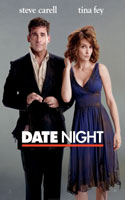
DATE NIGHT (2010)


Date Night is the perfect movie for couples who've been together a while, especially the married kind: those who can't seem to find time for each other anymore, whose work and kids consume them, whose sex life has fizzled, and maybe who are wondering if it's all worth it. In this entertaining romp, Phil and Claire Foster, played by Tina Fey and Steve Carell, are a couple trying to convince themselves that having one date night a week, to get away from the kids, go out to dinner, and maybe even have sex afterwards if they aren't too worn out, is enough to keep their marriage fresh.

Fey and Carell were born to be comic partners; the chemistry between them is golden.
In an attempt to spice up that night out, they decide to go the extra mile - all the way from the suburbs into New York City. Claire puts on a sexy dress and high heels and suggests the newest, chicest restaurant in Manhattan for dinner. (Spoiler alert here - though the surprises aren't really big enough to warrant one.) Naturally, when the Fosters get to the restaurant, there are no tables and the maitre d' sneers at their un-hipness. While waiting at the bar, listening to the hostess calling the names of parties to their tables, the couple realises that "the Triplehorns" haven't shown up. They assume the name and claim the table. Halfway into the meal, Claire and Phil are interrupted by a pair of thugs who mistake them for the actual Triplehorns and haul them outside for a reckoning. We come to understand that these erstwhile Triplehorn people have wronged some gangster boss by holding out on a flash-drive that he wants. When the Fosters manage to get away from the thugs, they realise that they won't be safe, nor will their children at home, unless they locate the flash-drive. Their endeavour to involve the police is thwarted when they see that the bad guys are actually dirty cops.
The plot is not a very complex one, nor very plausible, but director Shawn Levy did himself a huge favour by casting the incredible talents of Fey and Carell in the lead roles. They help make the script, written by Josh Klausner, extraordinarily funny. Fey and Carell were born to be comic partners; the chemistry between them is golden. And as an added bonus, the film may strike a hopeful chord with people who feel like they are drowning in the rut of their life and their relationship. In the midst of the dangerous predicament, the Fosters find moments to talk about their conjugal fears: they don't listen to each other anymore, they're losing their connection. They see their friends breaking up and it scares them. Phil also sees that Claire is attracted to a client of hers, a guy named Holbrooke, played by a gorgeous, shirtless Mark Wahlberg, whom they go to during the course of the night for help. Another wake-up call comes when Claire and Phil meet a crazy young couple, played brilliantly by Mila Kunis and James Franco, whose dysfunctional passion shows the Fosters that their own love lives are missing that lustful spark. Finally, they both manage to muster a level of bravery and smarts that make each see the other in a whole new light. The night of danger and action rekindles the flames of their desire. As you may have guessed, this is as much action movie as romantic comedy - emphasis on the comedy - but so much the better. You can watch it with the boyfriend or the hubby and he won't feel coerced into sitting through a chick flick. It's truly as much fun for the guys as the girls. Make it a part of your next date night. It might inspire the two of you to get out of your rut and do something just a little bit crazy.


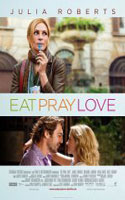
EAT PRAY LOVE (2010)


We were all expecting great things from the movie Eat Pray Love, even though we know from years of experience that the movie is never as good as the book. Still, we hoped, we prayed that this time would be the exception. Sorry. Director Ryan Murphy, like so many directors before him, could not accomplish that feat. Elizabeth Gilbert's book contains spiritual experiences and lessons and other details that cannot be or would take too long to be portrayed on film. And, if you've recently read the book, you will be griping about things that aren't said in the movie in exactly the same way, or that don't happen in the same sequence, or characters that are missing or combined or whatever. But if you've read it long enough ago to have forgotten a few details, or you never read it in the first place, you might just enjoy this one.

For the viewer who is just a viewer and not a reader, the movie is quite satisfying with its glorious cinematography, sensitive lighting, evocative imagery and gorgeous scenery.
That being said, the film is too long. This is because the first quarter is spent exploring the end of Liz's marriage, her affair and her divorce with too much extraneous stuff. Like the book, the movie really gets interesting when Liz lands in Rome. Here, the director manages to translate to us all the lusciousness of the city: its history, its language, its people and of course its food. We fall in love with it all just as Liz does and find ourselves never wanting to leave that cinematic reality. But then she whisks herself off to an ashram in India where we don't really get the impact of the spiritual connection that we imagine occurs (and know occurs if we've read the book). Finally there's Bali, where situations and happenstance will really seem jumbled around to the devoted book reader. However, for the viewer who is just a viewer and not a reader, the movie is quite satisfying with its glorious cinematography, sensitive lighting, evocative imagery and gorgeous scenery. And finally, there's the acting, which is what truly makes this film for both the devotee and non-devotee of the book. Julia Roberts is luminous. She gets Elizabeth Gilbert; she inhabits her, she seems to understand her on every level. She was the perfect choice for the role and it was absolutely providential that she was available and agreeable to doing the part - in fact was probably aching to do it. Her emotions are right there on the surface and she doesn't rely too heavily, as she sometimes does, on all her Julia Roberts charm. All the supporting actors are excellent as well, namely Richard Jenkins as "Richard from Texas"; Javier Bardem as Felipe, Liz's lover in Bali; Billy Crudup as Steven her husband; James Franco as David, her yummy but heartbreaking love interest in New York; Viola Davis as her agent, Delia; and especially Hadi Subiyanto as Balinese medicine man Ketut.

The important thing is that the film leaves you with the same overall feeling that the book does, glowing and happy and warm, though perhaps not quite as fulfilled. To sum up: If you are passionate about the book and expect an exact replica, don't see it. If you just want to see the memoir come to life (or were too lazy to read it) and are not picky about the details, definitely do.  
(By the way, to know where to find that amazing-looking fried artichoke that Liz was eating in Rome, check out my blog post on the subject at searching4sincerity.blogspot.com)


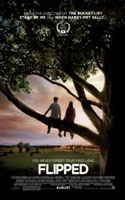
FLIPPED (2010)


I was looking around for a fun, light DVD to watch with my husband, and came across this little Rob Reiner gem called Flipped. Set in the late 50s/early 60s USA, it's about a young girl, Juli, who "flips" the first time she meets the new boy, Bryce, moving in next door. She innocently assumes he'll come to feel the same way about her as she begins her five-year quest to make him her guy. Reiner uses the ingenious tactic of showing the situation from her point of view, and then from his.

Every time she thinks she reads Bryce's meaning, through a look or a smile, it turns out, when we see it from his point of view, he means something completely different.
Being a girl, I naturally couldn't help siding with Juli, played by Madeline Carroll. Every time she thinks she reads Bryce's meaning, through a look or a smile, it turns out, when we see it from his point of view, he means something completely different. My husband, on the other hand, totally understood how Bryce, played by Callan McAuliffe, feels. A boy at that age just doesn't know how to deal with girls, much less smart, sensitive ones. But I couldn't help feeling frustrated with Juli. I kept thinking, why does such a bright, on-the-ball girl, interested in social issues, science and the world around her, want to be with such a dummy? The answer is simple: because he's cute. Yes, I remember that age. Looks are all that really matter. And, after all, it's not that Bryce is stupid, it's just that he's a 13-year-old boy, whose brain is maturing much more slowly than that of his female counterparts.

Based on the novel of the same name, by Wendelin Van Draanen, the film is truly charming. There is quite a surprising, top-notch cast on board too - I say surprising because, though most actors crave working with Rob Reiner, this is a small film, and the two adolescent leads are virtually unknowns. Their parents and other family members, however, are played by the likes of Rebecca De Mornay, Anthony Edwards, John Mahoney, Penelope Ann Miller and Aiden Quinn, all of whom turn in riveting performances. Though Flipped is not a movie that will necessarily rock your world, it will stay with you, and for all the right reasons.


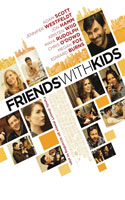
FRIENDS WITH KIDS (2011)


Friends with Kids is a film with a certain amount of appeal, though it disappoints in the long run. It's about two good friends, Jason and Julie, who have never been attracted to each other, but who decide to have a baby because she's getting older and he's into the idea of being a dad half the time as long as it doesn't interfere with dating. So they have sex just to conceive, or so they tell themselves, and soon have a darling baby boy whom they manage to care for with ease, grace and good humor. Their married friends, on the other hand, all seem to be disasters with parenting. They're always overwhelmed, they fight, and they lose their desire for each other. Julie and Jason feel, superiorly, like they're the ones who got it right. It's the perfect arrangement.

Their last "romantic" words to each other before falling into each other's arms are the least romantic I've ever heard.
Then Jason meets a really sexy girl, which possibly makes Julie a little jealous, until Julie meets the perfect guy, and then everything is fine, right? Well, of course not, which is why the plot of Friends with Kids is as unsurprising as most rom-coms. However, it's not totally uninteresting getting to that inevitable ending. For this, we have the supporting actors to thank: Kristen Wiig, Maya Rudolph, John Hamm, and Chris O'Dowd, who make up Jason and Julie's circle of friends, Missy, Leslie, Ben and Alex. It's surprising to see actors of this caliber in these lesser roles. We think of Wiig and Rudolph as the stars of movies such as Bridesmaids; Hamm, of course, is the dreamy scumbag Don Draper on Mad Men, and the charmingly Scottish O'Dowd has had plenty of leading-man roles in various rom-coms of late. Each is excellent as one of the couples (Missy and Ben, Leslie and Alex) who start off in a state of wedded bliss and end up completely derailed by the messy business of having kids. What's nice about the performances of all four actors is that they don't fall back on their usual shticks. The two comic actresses, Wiig and Rudolph, are real, poignantly portraying women who have lost some part of themselves in motherhood, while the men are multi-faceted, not just idiot husbands without a clue, or womanisers.

Jennifer Westfeldt as Julie and Adam Scott as Jason are somewhat less captivating. Their confusion about their relationship isn't quite convincing - or maybe it's just the predictability of the situation: they want each other, it's obvious, get on with it. She's a bit dithering, he's a bit shallow ... the perfect couple. But when they finally do get together, the romantic build-up is lacking. As a matter of fact, their last "romantic" words to each other before falling into each other's arms are the least romantic I've ever heard in any movie of this kind. Jason: I wanna **** the **** out of you. Julie: **** the **** out of me. And the credits role. Not my idea of a satisfying finale. Yet though the romance doesn't really work, you may to relate to Friends with Kids as a parent. If you're not a parent, it might not completely put you off having children forever, maybe just for a little while.


GHOSTS OF GIRLFRIENDS PAST (2009)


This gets off to a bit of slow start but you stick with it, because it does, after all, star Matthew McConaughey. He plays Connor Mead, a smooth, handsome jerk who has made an art of the one-night stand - to the extent that in the course of the first few scenes he breaks up with three girls at once on a conference call. He learned it all from his womanising Uncle Wayne, who has since passed away. He returns to Uncle Wayne's mansion for the weekend to celebrate his brother's wedding, having already slept with three of the four bridesmaids, and tries to convince his brother not to get married by bribing him with his Jaguar. There, he runs into childhood sweetheart/maid of honour, Jenny Perotti, played by Jennifer Garner. At the rehearsal dinner, he makes a speech condemning the institution of marriage - he is the marriage Scrooge in this A Christmas Carol metaphor.

He makes a speech condemning the institution of marriage - he is the marriage Scrooge in this A Christmas Carol metaphor.
The story picks up when the ghost of Uncle Wayne appears, a smarmy, stuck in the '70s kind of guy, played by Michael Douglas. He is the Jacob Marley of the story. He tells Connor that during the course of one night, he will be visited by three ghosts, who will help him see the error of his ways. Just when Connor is convinced that Uncle Wayne was a hallucination, Allison Vandermeersh, Connor's first sex partner, an apparition from the year 1986, appears in his bed. She is the ghost of girlfriend past, come to escort him through his many former exploits. The first of those is the 10-year-old Jenny, with whom he shared his innocent first kiss. Allison takes him through middle school, where Jenny unwittingly breaks his heart. At that tender age, his Uncle begins Connor's private education and teaches him how never to be hurt by a woman again. Throughout the ensuing years, Connor keeps blowing his chance to be happy with Jenny - one, because she doesn't buy his act, and two, he just can't get himself to commit. As Connor, McConaughey is fine, he's convincing. But Garner, simultaneously feisty and grounded, has that ability to let emotion flicker across her face at a whim. It is that face that keeps us, and Connor, believing in Jenny.
However, it is Emma Stone's spunky, '80s teen energy as Allison that keeps this film from being your typical schmaltz-fest. Lacey Chabert, as Sandra, is the ultimate bridezilla, while also managing to remain sympathetic, and adds great comic relief throughout. The dry and witty Noureen DeWulf plays the ghost of girlfriend present, Connor's quirky assistant, Melanie. It is these supporting actresses who really make the movie: wacky, clever, excellent comic timing all three. It's not just shots of shirtless McConaughey that keep us watching. The sexy, ethereal ghost of girlfriend future finally shows us the tragic future Connor will face if he doesn't change his ways. It's pretty cliche, seeing that it is, after all, based on the most famous Dickens story of all time dressed up in modern clothes. Fortunately, some clever dialogue and good performances save the over-worked plot, and we come away more satisfied than we expected to be when the movie began.


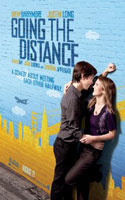
GOING THE DISTANCE (2010)


The only hope I had that Going the Distance would stand out from the recent list of rom-coms that I've seen and hated is that Drew Barrymore and Justin Long are the stars. Otherwise, I thought, what could be less original than a movie about a long-distance romance? Turns out I was wrong, and pleasantly surprised - original it is. What sets the film apart is clever, modern dialogue, a little edgy, but not overly crude, characters who know how to do comedy, and fantastic chemistry between Barrymore, who plays a journalist named Erin, and Long, who plays Garrett, a music industry up-and-comer. The new couple have to travel between San Francisco and New York to see each, trying to keep the spark alive.

It explores the reality of being in love but wanting to put your career first whether you're a man or a woman.
The supporting cast is full of great comic actors including Jim Gaffigan, Charlie Day, Jason Sudeikis and Christina Applegate. Surprising to see Applegate in the role of Erin's sister because she's usually playing the lead herself, but she gets extra credit for taking on this secondary role. She was so funny as neurotic-clean-freak-housewife and mommy that my husband and I actually had to pause the DVD we were laughing so hard. And while it's easy to think that a movie like this is going to end on a blissfully happy note, it doesn't quite give us that Hollywood-typical ending we're so used to in movies of this genre. And guess what? In spite of there being a lot of plane travel, nobody rushes to the airport to stop anybody from going somewhere, or dashes on to a plane for a confession of love! This is a movie with soul. It explores the reality of being in love but wanting to put your career first whether you're a man or a woman, and how in this day and age, you might just have to choose work over romance.
It's not a fairytale or a fantasy, just some real people in (mostly) real situations that make you remember how special being in love can be. Going the Distance will give you a much-needed break from the rat-race, the rut, or whatever you're stuck in, and give you that great big laugh you know you need.


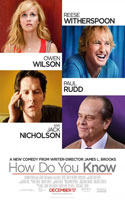
HOW DO YOU KNOW (2010)


How Do You Know is such a forgettable movie that I had to look at the title again and again to remember what it was called, but then I'm not a fan of vague film titles: As Good As It Gets, Something's Gotta Give ... I can never remember which movie is which. I rented How Do You Know for the big-name stars such as Reese Witherspoon, Owen Wilson, Paul Rudd and Jack Nicholson. How can you go wrong with stars like that? Well you can and this movie does. First of all, the plot takes a long time to rev up as we learn about all the baggage the main characters will inevitably bring to their relationships. Second, we never really like any of them, with the possible exception of Paul Rudd's character, George, but only because he is played by Paul Rudd, who, by the way, is trying too hard to be Paul Rudd.

Witherspoon can usually carry a film with her charm, ... and Rudd with his physical comedy but none of them add any level of interest to the dull plot.
Reese Witherspoon was not believable as ineloquent, washed-up athlete Lisa, who unluckily falls into a relationship with superstar baseball player Matty, played by Owen Wilson. He, at the top of his career, does not really comprehend the meaning of the word "fidelity" and Lisa flails between a relationship with him and her growing feelings for troubled executive George. Witherspoon can usually carry a film with her charm, Wilson with his sexy goofiness, and Rudd with his physical comedy, but none of them add any level of interest to the dull plot, and less-than-snappy dialogue. Jack Nicholson was pointlessly cast as George's father, appearing in only a handful of lacklustre scenes.

So how much money did director James L. Brooks (writer/developer of The Simpsons and movies such as Spanglish and Terms of Endearment) spend on How Do You Know - $US120 million, to be precise, (evidently spent on the star-spangled cast). I was amazed I had never heard of the film before until, more than halfway through, I recognised a scene from the trailer and realised that I had heard of it, and, at that time, thought it looked like a lot of fun. It was so not fun, that it never recouped its budget at the box-office, nor managed to hold my interest for the duration of the film. I won't give it the lowest rating possible, because I have actually seen worse films, but it's definitely going at the low end of the spectrum. It wasn't a total waste of my time because I spent the long two hours catching up on Facebook but it was certainly a waste of a video rental.


IT'S COMPLICATED (2009)


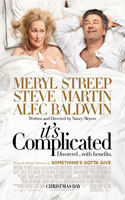
It's Complicated isn't, really. This is a movie to rent (or better yet get free On Demand) when you just want a little something pleasant, an evening's distraction, maybe a few laughs. It's a film aimed at the menopausal set ... not that there's anything wrong with that. Women sit around with their wine glasses laughing about men and sex, while the men sort of flail around without a clue about how to deal with the women in their lives. There's a bit of stereotyping going on here on both ends, by writer-director Nancy Meyers, which may not ring true to many viewers.

Thankfully, the high-quality actors help make the film watchable, though they are rather wasted on the non-complicated story.
Thankfully, the high-quality actors help make the film watchable, though they are rather wasted on the non-complicated story: divorced couple has a fling, former husband Jake falls back in love with former wife Jane while cheating on new wife Agness, as Jane is trying to move on with new boyfriend Adam. That's about it. Why are the stellar talents of Meryl Streep and Steve Martin required? Please, they could do it in their sleep. And the likes of Rita Wilson and Mary Kay Place cast in teeny roles as part of Jane's supportive klatch of friends is simply a waste. Alec Baldwin is fine for his part as Jake; he's funny, he's smarmy; he's Alec. But Meryl doesn't particularly shine in this average role as an average woman. Give Ms Streep a character and an accent and she'll bring you home another Oscar nomination, yet for the part of Jane Adler, a lesser actress would have been sufficient.
On a positive note, cute and comical John Krasinski, from the American TV show The Office and the 2011 film Something Borrowed, provides a youthful balance as Harley, the fiance of Jane's oldest daughter. Krasinski supplies plenty of laughs with his wry remarks and expressive face, discovering Jane and Jake's indiscretion before anyone else in the family. But the highlight of the film is when Jane and Adam (played by Steve Martin) get high smoking marijuana and attend the graduation party of Jane's son. Here, their acting talents pay off with some genuinely uproarious moments. Ultimately, it's a movie worth seeing if you see it without very high expectations, maybe even with a group of friends and plenty of wine. And though perhaps it's reasonable to expect more from a Meryl Streep movie, It's Complicated is at least an uncomplicated good time.


JANE EYRE (2011)


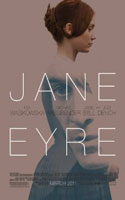
Jane Eyre is one of the original chick lit novels. How many of us as young readers were carried away by the idea of the plain governess attracting the notice of the tempestuous lord of the manor? Certainly many romance novels have been inspired by that theme. But while bodices may be wildly ripping in those copycat stories, nothing so untoward ever happens in Jane Eyre, book or movie. In the latest film incarnation of the Charlotte Bronte novel (there have been many, going back to the version with Orson Welles in 1943, and including a 1996 Zeffirelli version with Anna Paquin, William Hurt and Charlotte Gainsbourg), a not-quite-beautiful and very understated Mia Wasikowska plays Jane Eyre, and the relatively unknown, at least in my American eyes, Michael Fassbender plays Rochester. As a matter of fact, the only very recognisable actor in this 2011 version, directed by Cary Joji Fukunaga, is Judi Dench, who plays Rochester's housekeeper, Mrs Fairfax.

The desire that hovers just below the surface for Jane and Rochester is palpable, delicious, tantalising.
As usual, I sat down to watch the DVD with my poor, long-suffering husband who is often subjected to my chick flick picks, and he was instantly confused by the flash forwards and flashbacks with which the film begins and which last for the first 20 minutes or so. And though I haven't read the novel for many years, I've read it enough times to be able to explain to him what was happening. That said, if you haven't read the book, you might be confused by the first part of the film. But stick with it. For soon thereafter, everything becomes clear, and besides, I don't know how you will be able to look away from the gorgeous scenery and enchanting cinematography. And every performance is excellent. Director Fukunaga obviously understands the novel intimately enough to be able to draw exactly the right levels of passion and restraint from his actors, so much so that the desire that hovers just below the surface for Jane and Rochester is palpable, delicious, tantalising. I was on the edge of my couch whenever they spoke to each other, even though Fassbender is not really what you'd call a hottie. The director knew to rely on the leading man's soulfulness, not needing a Colin Firth or Colin Farrell or any other Colin. Fassbender is downright odd-looking, but you understand Jane's deep love for him as certainly as you feel his yearning for her.
This tale is Gothic fiction embodied. It's got it all - the windswept hinterlands, the tragic orphan, the troubled solitary gentleman with a terrible secret, the spooky castle with the strange, haunting sounds emanating from a hidden room ... and the semi-tragic ending. And speaking of the ending, it always slightly bothered me in the book. I always thought Mr Rochester ultimately lost too much of his sex appeal, and I was fairly disappointed to see that the same is true in the movie. I mean, I'm a firm believer in the film following the book closely, but this time I really wanted Rochester to end up looking less homeless. Call me shallow. However, all in all, this is a beautiful film and an eternal story. Curl up with it on a rainy night and get swept away through the heath on the moors. What chick among us doesn't love that?


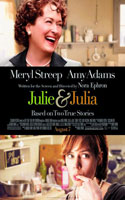
JULIE & JULIA (2009)


Julie & Julia, directed by Nora Ephron, is decidedly more a movie for women than men, but anyone who thrills to watching the genius Meryl Streep at work will want to settle in with this one on a rainy night. It's one of those films you can return to again and again as a true feel-good film. As with every role Streep plays, she completely embodies the character, in this instance the irrepressible Julia Child, famous television chef and cookbook author. It is incredibly fun to watch Streep having fun while her character Julia is having fun, which the famous chef seems to do nearly all of the time as a result of her pure joie de vivre. Julia Child's lust for life, especially in the form of food, is contagious.

More than anything, this is a movie for people who love to eat, love to cook, or would love to be able to cook.
One cannot say as much for the somewhat whiny Julie Powell, the frustrated writer, played by Amy Adams who, in the year 2002, blogs about her attempts to cook all 524 of the dishes from Julia Child's Mastering the Art of French Cooking, over the course of 365 days. (Powell's memoir was released in 2005.) The film bounces back and forth from the past to the near-present. And while Julia's life is much more engaging than Julie's, watching the younger woman's day-to-day frustration keeps the viewer a bit grounded in reality, lest one gets too wrapped up in the fantastical life of Julia Child's 1950s France.
It's not that Julia Child had a trouble-free career as cooking student, teacher and author. It's just that in spite of her disappointments and downfalls, she maintained incredible courage and good humour. Also gratifying to watch is the portrayal of her marriage to Paul Child, played with irresistible sweetness and charm by Stanley Tucci. It's a relationship that any modern married couple might aspire to. More than anything, this is a movie for people who love to eat, love to cook, or would love to be able to cook. It's also a film for those who simply love to bask in some wonderful performances. Julie & Julia may not be a life-changing cinematic experience, but for many food and feel-good film fans it will become one of those comfort movies that they might curl up on the couch with bowl of macaroni and cheese on hand. It may not be Julia's Boeuf Bourguignon but one can always fantasize.


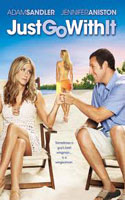
JUST GO WITH IT (2011)


I take it as my solemn responsibility to bring movies to the attention of Chicklit Club readers that I think they would be interested in. Not all the films I review are based on chick lit books but I try at least to look for films that are rom-coms or romantic in theme, or else deal with subject matter that generally appeals to women - chick flicks, in other words. Sometimes my purpose becomes to warn viewers away from a film they might be drawn to thinking it's a chick flick because, either it isn't or, it's just really not worth their time.

And while Adam Sandler managed to make a couple of great rom-coms, he's lost his touch with this one.
Just Go With It fits into both of those categories. I picked it up because it stars Jennifer Aniston, Adam Sandler, and, lo and behold, Nicole Kidman! An odd mix of a cast, I'll admit. Well, I discovered it's definitely not a chick flick - there's too much focus on large breasts and poop humour to qualify. And while Sandler managed to make a couple of great rom-coms with The Wedding Singer and 50 First Dates, he's lost his touch with this one, both as a comic actor and a producer. There are a few scant laughs in the film, mostly due to Aniston's skill as an actress, but most of the acting is terrible, and the story is so predictable. Here's the plot: Danny (Sandler) normally meets women by wearing a wedding ring and telling sob stories about his terrible wife; he accidentally takes it off, meets hot girl Palmer (Brooklyn Decker), she falls for him, finds the ring, and thinks he's really married. He convinces his assistant Katherine (Aniston) to pretend to be his wife, complete with kids, so that he can show Palmer that his wife no longer loves him and that they are planning a divorce. Now, could someone please tell me what Nicole Kidman is doing in this movie? She plays Katherine's college nemesis, Devlin, who shows up more than halfway through, to plague Katherine as she's trying to help Danny pull off his charade.
Normally one of the finest actresses, she's terrible in this film mostly because her character and dialogue are ridiculous. I was also distracted by what I think may be some odd cosmetic surgery she's had. And though guys might enjoy what comes down to a dance-off between her and Aniston's character, showing off both of their spectacular bodies, for the ladies, there is nothing to recommend this film. Don't waste your time, gals; maybe just watch The Wedding Singer again instead.


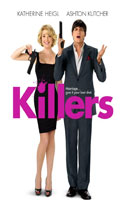
KILLERS (2010)


A film with a name like Killers is not one you'd think would necessarily be geared towards women. And yet, it's very much a romantic comedy, with a little murder thrown in for fun. The fine cast includes Ashton Kutcher, Katherine Heigl, Tom Selleck and Catherine O'Hara. Heigl plays Jen Kornfeldt, a conventional girl who's just been dumped by her nerdy boyfriend. (Minor spoiler alert.) She goes on vacation to Nice, France, with her parents (Selleck and O'Hara). There she meets hottie Spencer Aimes (Kutcher) who, unbeknownst to her, is a paid assassin. His attraction to her makes him lose his stomach for the job as their quirky romance quickly leads to marriage.

The twists keep us guessing, the acting and comedy keep us entertained, and Kutcher's abs ... well enough said.
They've settled into a comfortable existence of mundane normalcy when Spencer finds his life suddenly on the line from unexpected threats. Jen, by association, also becomes a target. At this point she realises that she doesn't know the man she's been married to for three years, and their relationship breaks down. Sound a little like Mr. and Mrs. Smith? Nah. It's a film with much more heart and less than half the violence. Spencer has to protect his woman and win her love all over again. There's a real family here and real relationships that need to be fostered. The twists keep us guessing, the acting and comedy keep us entertained, and Kutcher's abs ... well enough said. Heigl has proven herself time and again to be an excellent comic actress and does so again here. Kutcher is his usual amusing self. I actually think his acting is getting better and I'll bet he does a lot of the realistic-looking stunts himself. Selleck is drily funny but though O'Hara is always good, I wasn't fond of her in this role as the adorably tipsy mum. Alcoholism stopped being funny after Arthur.


If you are a person who objects to any violence at all, this film isn't for you. However, there's no need to be alarmed. There's actually very little blood; the movie is much funnier than fierce - definitely one that you and the boyfriend or husband can enjoy together. Don't be fooled by the title, Killers is a real charmer.


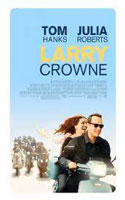
LARRY CROWNE (2011)


The film Larry Crowne is billed as a romance, but I had a hard time getting romantic about it. First of all, and forgive me for saying this, but Tom Hanks is just not romantic-leading-man-material any more. Not only that, but it took me a long time to figure out what the deal was with his character (which is, of course, Larry Crowne). Larry is so enthusiastic about his job at a big box store (ala Walmart), and so seemingly clueless about how life in general works, that at first I thought maybe he was a little slow, that Hanks was reprising his Forrest Gump role. Larry gets fired from his job because he doesn't have a college education (I'm sorry, you need a bachelor's degree to work at Walmart?) so he enrols in some courses at a community college. There, the other, much younger students are so friendly I suspected them of double-dealing. But no, they're just a bunch of community college kids anxious to let some 50-plus guy into their little group. Is this how community college always is? Maybe the writers of the screenplay, Hanks and Nia Vardalos (star and writer of My Big Fat Greek Wedding), took their cues from the American TV show Community. Nevertheless, it struck me as rather unrealistic.

A sad, aging divorcee, Roberts plays the part with a tour de force which was the only thing that kept me watching.
The one, true, shining example of reality in this film is Julia Roberts' character, Mercedes Tainot, Larry's speech class instructor. She's cranky and she drinks too much. A sad, aging divorcee, Roberts plays the part with a tour de force which was the only thing that kept me watching. You don't need a spoiler alert to keep you from guessing that Larry and Mercedes get together in the end. Still, it seems unlikely that this brilliant, beautiful woman would go for Larry, no matter how lovely a human being he may be on the inside, or how damaged she is. Yet that point brings me back to the writers, Vardalos and Hanks. The only other film that Hanks wrote that really stands out is the 1996 charmer, That Thing You Do. Vardalos has written a few things since My Big Fat..., all of them atrocious, except for the 2004 Connie and Carla. Okay, so they have a couple of decent movies under their belts; that doesn't make them a crack writing team, which is entirely evident in the case of Larry Crowne. Besides, I feel like Vardalos' idea of strong characters is to have everyone be super nice and smile all the time. Oh, and did I mention Hanks directed it? In my opinion, he needs to utilize his considerable talents elsewhere, and Roberts needs to steer clear of a bad script even if her good pal Tom Hanks asks her to do it. She's too good to waste her talents on the likes of Larry Crowne. Not the worst movie I've ever seen, just highly forgettable. After writing this review, I doubt I'll ever think about it again.


LEAP YEAR (2010)


How many times have you seen this movie: girl is thrown together with boy, girl hates boy because he's rude and obnoxious, girl and boy engage in a war of wits, are coerced into kissing, somehow end up sharing a bed; ultimately, girl sees boy as hunky and virile, girl and boy fall in love? It's as old as The Taming of the Shrew. In the case of the film Leap Year, our Shakespearian stand-ins are Matthew Goode and Amy Adams and the scene is set in Ireland. Now certainly, Adams is a very fine actress as evidenced in films such as Doubt, Miss Pettigrew Lives for a Day and Julie & Julia. But it's baffling why she would choose to do this film other than perhaps the fact that her red hair looks good against the landscape of the Emerald Isle and the high heels and tight skirts she wears while tromping through muddy fields nicely set off her perky butt.

It's baffling why she would choose to do this film other than perhaps the fact that her red hair looks good against the landscape of the Emerald Isle.
OK, so here's the plot: Anna (Adams) wants her dull and predictable boyfriend (Adam Scott) to propose. He goes to Dublin for a medical conference, and she decides to take advantage of the Irish tradition of Leap Year and fly there, surprise him and propose. But low and behold, the fates transpire to prevent her from getting to him before February 29, instead, plopping her in a podunk town in rural Ireland. There, Declan (Goode), the handsome yet irascible owner of an inn, agrees to drive her to Dublin and, of course, falls in love with her along the peril-fraught way. The rest is easy to predict. Every moment of this movie is easy to predict.
However there are a few redeeming aspects, most notably among them, the scenery. It's almost as if director Anand Tucker was determined to make a film, any film, in Ireland in order to show off the island's great beauty. In this, he succeeds. Leap Year is visually a wonder: vast green hills, dramatic cliffs, soaring castles; it definitely keeps you watching. And then there's the adorable Matthew Goode and the natural charm and appeal of Amy Adams which manage to shine through no matter how lame the script. Don't rush out to the video store for this one but when you eventually get around to watching it, you'll find you know what to expect from the very first frame, even if you've long forgotten about this review.


LES MISERABLES (2012)


Let me start by saying that I'm not a huge fan of musicals, though, strangely, I tend to like them better in movie form than on stage. As a result, I've never seen Les Miserables on Broadway (though I live in New York City) so I had nothing to compare the film to. Fans of Les Mis, the show, were wild to see the movie, and the ones I know loved it. As a member of the Nominating Committee for the Screen Actors Guild, I was invited to the very first public viewing of the film. Eddie Redmayne, who plays Marius; Amanda Seyfried, Cosette; and Samantha Barks who plays Eponine, were there in the audience, seeing it for the very first time as well. Director Tom Hooper came out and introduced the film before it started, and afterward, he and Anne Hathaway joined the other actors for a Q&A with the audience. Therefore, I was watching with a certain heightened level of excitement, and perhaps was less critical than I would have been otherwise. The audience rose to a standing ovation after the film, and remained so as the actors came in to take their places for the chat. It was such a thrilling experience it wasn't until later that I really had a chance to analyze the picture. I'll start with the synopsis - so if you don't want to know what happens , skip the following paragraph.

I'm glad that (director Tom) Hooper allowed the singing to be a little less perfect so the acting could be more intense.
For those that haven't read the novel by Victor Hugo, (and I highly recommend you do; it's better than any film or stage version could ever be) Les Miserables is the story of Jean Valjean, a man sentenced to 20 years of hard labor for stealing a loaf of bread. After he's released, he breaks parole, which puts police Inspector Javert forever on his trail. Lying low, Valjean makes a good life for himself as the owner of a clothing factory. When one of his workers, Fantine, is unfairly fired by his foreman, and must resort to prostitution to support Cosette, her daughter, Valjean feels responsible and goes to save the tragic woman. It's too late, she's dying, but he vows to take Cosette as his own child and raise her as a lady, essentially buying her from scheming innkeepers Monsieur and Madame Thenadier, who use her as their servant. All this time he's pursued by Javert, who keeps adoptive father and daughter on the run. Once she's grown into a lovely young woman, Cosette meets a wealthy young man (Marius) and they fall in love, while Eponine, daughter of the Thenadiers, watches him slip away from her grasp - for she loves him too. All of this unfolds in the shadow of the French Revolution of 1848, and ends with Marius and Valjean in the midst of the cause, where the older man saves Marius' life and finally undoes Javert. Ultimately, he gives his blessing for Marius and Cosette to marry, while his own life breath fades.

If you're expecting the very best vocal performances in this version of Les Miserables, you may be disappointed. Many of us know by now that the singing was recorded live, accompanied by a pianist on set as Hooper was shooting, and the orchestral music was filled in later. This sometimes makes for some fairly raw vocals, though that doesn't matter much to me. I'm glad that Hooper allowed the singing to be a little less perfect so the acting could be more intense. I was extremely moved by Hathaway's Fantine and by Hugh Jackman's Jean Valjean. Both, though not the strongest singers, are extremely powerful in conveying the emotion of their roles. Russell Crowe as Javert I could take or leave. Yet two of my favorite performances were those of Helena Bonham Carter and Sacha Baron Cohen as Madame and Monsieur Thenadier, the delightful comic relief. (Who knew Borat could sing?) They portray the parts with flawless timing - perfect roles for the two quirky actors, making me wish, in retrospect, that they'd gotten more recognition in terms of award nominations. I liked Seyfried as Cosette very much - she has a sweet high soprano that really suits the part, and Redmayne's Marius brings just the right touch to the romantic story line. Another of my favorites was Barks' Eponine. She is one of the few true musical-theater performers, by trade, in the cast, and brings a lovely pathos to her part that moved me to tears, mostly done while singing in the pouring rain - so extra kudos for that. The film is a long, and unless your husband is all atwitter about musicals and epic tales of love and tragedy, I wouldn't drag him through it. My husband liked it okay, but then he doesn't mind the occasional musical, and besides, he was so agog to be in the presence of the adorable Hathaway, that he had nothing to complain about. Watch it with your girlfriends instead and sob to your hearts' content. Les Miserables is a rewarding three hours spent.


LETTERS TO JULIET (2010)


I was sure I wasn't going to like Letters to Juliet. Everything I knew about it pointed towards schmaltz and sappiness. The one, no, the two things that lured me into watching the film were Vanessa Redgrave and Italy. Give me a film set in Italy and I'm there. Give me a legend of the screen such as Ms Redgrave and I'm generally on board. So I sat down to watch it with my husband (he was certain to despise it) and, though we were a little put off at first by Amanda Seyfried's lack of energy as she portrayed Sophie, an aspiring journalist, we were encouraged by the dynamic Gael Garcia Bernal who played Victor, her restaurateur fiance.

Seyfried's energy improves on embarking upon the expedition, and she proves herself a very emotionally connected actress.
As soon as the action shifted to Italy, Verona to be specific, we were transfixed. And when Sophie, on a food tasting trip with Victor, discovered the wall beneath the legendary balcony of Juliet's, where lovelorn women have been leaving their letters to Juliet for decades, we were hooked. Beyond that, a brigade of well-meaning ladies, "secretaries to Juliet," as they're called, actually collect and answer the letters every day - a wonderful premise based on the book, Letters to Juliet: Celebrating Shakespeare's Greatest Heroine, the Magical City of Verona, and the Power of Love, by Lise and Ceil Friedman. I haven't read the book but from the description, it seems as though it's a study of this incredible phenomenon which actually occurs in Verona, and it inspired the love story that the screenplay brings to life.
That story is quite sweet. Sophie finds a 50-year-old letter from a girl named Claire, who abandoned her Italian lover all those years ago, rather than elope with him. Sophie writes a reply to Claire's letter, and days later it brings the elderly woman and her grandson to Verona to track down Claire's long-lost love, Lorenzo. Claire and Sophie form an immediate bond and the older woman invites the younger to come along on the quest. The reluctant grandson, Charlie, played by Christopher Egan, continually tries to dissuade what he considers the sheer insanity of the journey, afraid that his grandmother will be disappointed. Disgusted by Victor's lack of attention to her, Sophie becomes more and more involved with Claire and Charlie's lives. Here, the story becomes rather predictable. But the trip south to Tuscany and throughout the region, the beautiful cinematography and the lively humour redeem it all. Seyfried's energy improves on embarking upon the expedition, and she proves herself a very emotionally connected actress, while Redgrave does not disappoint as the fragile but spirited Claire. Egan doesn't thrill as the cranky Christopher, but perhaps it's the character. Ultimately, the romantic story satisfies and won both me and the man in my life over. As Letters to Juliet proves, miracles do happen.


LIFE AS WE KNOW IT (2010)


Life As We Know It could refer to just about anything. Readers of my reviews know I have a problem with nondescript titles like this because I can never remember them, or which movie they refer to. In this case, the film in question is about as forgettable as its title. You've probably seen trailers for this movie; it's the one with Katherine Heigl and Josh Duhamel in which their characters, Holly and Eric, inherit a baby from their best friends who die in a car accident. Naturally, they dislike each other immensely, though they are pretty much forced to share their friends' home in order to raise the one-year-old in a familiar environment. Naturally, the situation brings them together in spite of other love interests and many arguments, and they fall in love. I'm giving away nothing to clue you in on this oh-so special plot.

Their characters, Holly and Eric, inherit a baby from their best friends who die in a car accident. Naturally, they dislike each other immensely, though they are pretty much forced to share their friends' home in order to raise the one-year-old in a familiar environment.
But, you say, at least both main characters are attractive, (Duhamel is sexy in his skivvies) and the baby is cute. Well, yes, in theory. However, Duhamel doesn't do it for me. I don't go for that all-American squared-jawed ideal. And I won't even comment on the acting - it's passable. I always enjoy Heigl, but she's got to start doing meatier parts. When she was on Grey's Anatomy she had so many opportunities to shine, was so much more than a pretty face. Now, she's just another rom-com queen. Finally, and this is all that really stood out for me in relation to Life As We Know It, I don't appreciate children being treated badly on film. There's always the disclaimer about animals not being mistreated in movies, but you never see it for children. That's because it's up to their parents to decide how far they are willing to let the filmmaker go. My husband and I were outraged at the scene that they kept showing in the trailers where the baby stands up to take her first steps, Eric pushes her right back down because Holly isn't there to see it yet, and the baby starts to cry.
There were no cutaways, no special effects, just a baby being pushed down and crying. It's not funny and they shouldn't have done it. That said, the baby, Sophie, was played by three different triplets, Brooke, Brynn and Alexis Clagett. Here is an excerpt from their bio on IMDB (the same one for all three, by the way, as if they're completely interchangeable): "Spending 11 weeks in Atlanta filming Life As We Know It was definitely an adventure for Brynn (and Brooke and Alexis) and she loved every minute of it. So many new friends - actors, producers, costumers, production assistants, drivers and many others - showered her with affection and attention. She loved going to the set and it showed in her comfort in front of the cameras." - Erin Clagett. I wonder which one of them got to be pushed down? Maybe I'm just being cranky. Life As We Know It is certainly not the worst film I've ever seen, but if it weren't for worrying about the wellbeing of the babies involved, I'd have already pretty much forgotten about it.


LIKE CRAZY (2011)


Like Crazy is a film I was really looking forward to. Yes, I said to myself, it's another romance about long-distance relationships, but there was something about the trailer that seemed soulful to me. Soulful is indeed an apt word for Like Crazy but that is the extent of the positive adjectives I can use to describe it. Alright, I'll add 'beautifully photographed'. But if we're adding adjectives (or adverbs), I'm also going to have to tack on 'unrealistic,' 'tedious' and 'irritating.'

It's a loving and tender connection they have for each other, a connection that is strained the more they continue to fight with Immigration. This is where 'unrealistic' comes in.
'Soulful' describes the relationship that forms between Anna, a Brit, and Jacob, an American, two students attending college in Los Angeles. After graduation, Anna is required to go back to England, but, on a whim, stays longer than her visa allows. After that, she's denied entry into the US and Jacob and Anna's across-the pond-relationship is tested to its limits. It's a loving and tender connection they have for each other, a connection that is strained the more they continue to fight with Immigration. This is where 'unrealistic' comes in. The fact that two people in their early 20s think they can hold a relationship together, especially when, as the other person is out of sight they seem to also be out of mind, just doesn't cut it with me. Anna and Jacob are constantly getting involved with other people. Their relationship is a continual back and forth between, 'let's make it work' and 'let's move on'. This is when the film becomes tedious for me; the couple's wishy-washiness is what makes it so irritating.
Like Crazy is beautifully filmed, which kept me watching ... that, and the performances given by Felicity Jones as Anna and Anton Yelchin as Jacob. Actually, all the actors are quite good, especially Anna's parents, played by Alex Kingston and Oliver Muirhead. They portray understanding, funny people who are loving and encouraging parents, and I ended up feeling sorry for them for having such an addle-headed daughter. I also felt extremely sorry for the two people who were always the interims in Anna and Jacob's lives. They seemed to be willing to be cast aside at a moment's notice. All in all, Like Crazy was a disappointment. Maybe it's just me; perhaps it would appeal to young lovers. I suppose life has made me too practical to put up with such silliness. After all, there's a difference between being crazy in love, and being simply crazy. You decide which one applies in this case.


LOST IN AUSTEN (2008)


Imagine how excited I was, Jane Austen freak and time-travel writer that I am, to find a film called Lost in Austen. This miniseries is based on an interactive novel by Emma Campbell Webster, which apparently is not at all like the series. The book sounds interesting, and I was equally intrigued by the premise of the series: a modern girl, Amanda Price, who is obsessed with Pride and Prejudice, trades places with Elizabeth Bennet by going through some kind of portal in her shower. She finds herself in Longbourn, home of the Bennet family, trying to explain her inappropriate clothing and what happened to Elizabeth. She manages to make up some believable tale about Elizabeth, and obtain some period-correct clothing, but retains the same modern hairstyle and make-up through-out.

I thought it was stupid that Amanda reads P&P over and over and over, and not any other of Austen's novels.
Strike one: why wouldn't Elizabeth's older sister Jane, or Mrs. Bennet, or someone, fix the girl's hair? She wears it in this blow-dried, modern hairstyle throughout, and no one seems to notice. Strike two: I didn't like the actress, Jemima Rooper, who plays Amanda. She's clunky and mannish and not the kind of woman any of us would think could appeal to the man who falls for Elizabeth Bennet in Pride and Prejudice, Mr Darcy (played in this case by Elliot Cowan). And yet she manages to win him over with her independent ways, while the real Elizabeth Bennet gets a job as a nanny in modern London. Amanda and her machinations manage to mess up Austen's beautifully crafted story line so much that Jane Bennet and her love interest, Bingley, don't end up together. Bingley, as a matter of fact, becomes an alcoholic, and Elizabeth's best friend, Charlotte, doesn't end up with the Bennets' cousin Mr Collins, but rather becomes the bitter old maid that in P&P she was trying to avoid being. And the antagonist of P&P, Mr Wickham, is redeemed - he's not such a bad chap after all! What?! Hey, I'm fine with all the updated versions of Jane Austen novels like Bridget Jones's Diary and Clueless, and I'll watch just about any film version of any of her novels, but when you start to mess with the actual plot of Pride and Prejudice, I say, hold on there, hands off! It irritated me immensely to think that the screenwriter, Guy Andrews, felt he had licence to screw up such a beautiful story. Apparently, in the book Lost in Austen, you can create your own plots, which is fun, but I'm not happy to be subject to Andrews' unpleasant imagination. Did I get to strike three yet? Well, I have one more to add: I thought it was stupid that Amanda reads P&P over and over and over, and not any other of Austen's novels.
If you love Austen that much, you would read her other works, not just P&P to the exclusion of all other novels. It was as if Andrews was making all lovers of P&P out to be nitwits; like the only reason we even like P&P is because we all want to marry Mr Darcy. Though that may be true to some degree, perhaps many of us also love Austen's delicious satire, her beautiful descriptions, her vivid characters and all of her engaging works. All in all, Lost in Austen is one-level stab at a multi-faceted story, not at all appreciated by this time-traveler/Jane Austen fan.


LOVE AND OTHER DRUGS (2010)


It sounds like the title for a rom-com, but Love and Other Drugs is not exactly that - certainly not unless you find Parkinson's Disease funny, and most of us, assuredly, do not. Yet there is plenty of humour infused in this tender and extremely sexy romance/drama starring Anne Hathaway and Jake Gyllenhaal. Jake's character Jamie Randall is a drug rep for a major pharmaceutical company, a fast-talking ladies man who will bulldoze over anyone to make a buck, and who prides himself on his many sexual conquests. But when he meets the beautiful and self-assured Maggie Murdock, played by Hathaway, he knows he's met his match. He gives his all to make her fall for him but Maggie is in the first stage of Parkinson's and doesn't want to involve anyone in her illness. This all takes place in the 1990s when doctors in the US are handing out samples of anti-depressants like candy. Thus, the drug rep meets the patient in a doctor's office where she's exposing her breast for examination.

Sadly, he doesn't have anything in his bag of tricks that will cure Maggie, and she pulls away from him as her symptoms get worse.
And the movie just gets sexier from there as Maggie agrees to a relationship that is mostly just physical. There are so many fairly explicit sex scenes, (plenty of nude shots of both of them in case you're interested), that I began to grow uncomfortable watching it with my mother. Then, of course, when Viagra hits Jamie's sample list, things get really crazy. Sadly, he doesn't have anything in his bag of tricks that will cure Maggie, and she pulls away from him as her symptoms get worse. The plot, though not entirely unpredictable, is satisfying and ultimately realistic.
This is one of the best performances I've seen from Hathaway though I always love her work. I've never seen her play such a sensual character, but, boy, can she do it. At the same time, she is not afraid to be unattractive in this role. The disease pulls Maggie so far down that she cannot fight it, and at that point the make-up, hair and cute clothes all go out the window. She is left at her most raw and vulnerable - amazing to see a popular actress go to such lengths (so much so, that I found myself thinking she should have been nominated for an Academy Award for this role). Gyllenhaal was fine in the film, no argument there, but Hathaway is always the stand-out. Love and Other Drugs is definitely one for your DVD list - just make sure you don't watch it with mom.


MIDNIGHT IN PARIS (2011)


Most people don't think romance when they think Woody Allen. Yet what are the characters in his films always longing for? Love. Even in his bitterest stories, the plot revolves around love: searching for it, finding it, losing it, complaining about it, envying it, stomping on it, taking it for granted, laughing at it, but sometimes, just sometimes, holding onto it. Midnight in Paris touches on all those aspects of love, and leaves us with a small ray of hope for holding on to it ourselves. Hapless writer Gil, played by Owen Wilson, is in Paris with his fiancee, Inez (Rachel McAdams), and her parents. Gil is in love with the romance and beauty of the City of Light, but Inez's main interest is to shop for furniture for their new home in California.

Midnight in Paris touches on all those aspects of love, and leaves us with a small ray of hope for holding on to it ourselves.
Late one night, Gil decides to walk back to their hotel rather than go dancing, and ends up getting lost. As the clock strikes midnight, an old-fashioned car pulls up, and the beautiful people inside invite him for a ride. They take him back in time, to Paris of the 1920s, an era when artists and revolutionaries smoked and drank late into the night, arguing about art and politics and living the life they wrote about and expressed in paintings. Gil meets Hemingway, the Fitzgeralds, Salvador Dali (Adrien Brody), Cole Porter, Picasso, and Pablo's charming mistress, Adriana (Marion Cotillard). The next night, Gil tries to get Inez to return with him to the spot where the car picked him up, but she isn't interested in his stories of Paris long ago.
As the plot progresses, Gil continues to meet the midnight car that takes him to the past, becoming more and more enchanted with the people, the time, and especially Adriana. He meets writer and art maven Gertrude Stein (Kathy Bates), and she agrees to read and critique his novel. All the while, he and Inez are finding they have less and less in common. But the night he decides to take things farther with Adriana, a carriage rolls by and delivers them both even further back in time: to the Belle Epoque, where they encounter artists Lautrec, Gauguin and Degas.
Whether you like Woody Allen or not, there is no disregarding this gorgeous film. Though Allen has tampered with flights of surrealistic fancy in his films before (Alice, The Purple Rose of Cairo), Midnight in Paris combines that with the best of all his movies: original story and dialogue, clever humour, quirky, spot-on acting, unparalleled lighting and cinematography, charming music, and his particular way of making the city in which he's filming, (usually New York, London or Paris) a character in itself. He shows it off in at its most beautiful, and makes us fall in love with it too.
It's probably obvious that I'm a huge admirer of Woody Allen's work, but as a fan and writer of time-travel fiction, I'm drawn to Midnight in Paris for that aspect as well. The things that Gil does in the present affect the past, and vice versa, the ultimate message being that we tend to want most what has gone before. However, though I may romanticize Allen's "Manhattan" and "Annie Hall" period, the reality in which he creates films like Midnight in Paris is the one I want to live in.


NEW IN TOWN (2009)
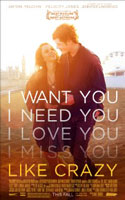

Though not a major stand-out as far as romantic comedies go, there is still a certain something that makes New In Town special. The premise follows a fairly typical plotline: the stuck-up city girl doesn't fit in with the small town folk. She initially rejects the local hunk, and vice versa, but the innate goodness (and sexiness) of each eventually shows itself and, of course, they fall in love. How many endless variations are there of this story? And the pencil-skirted, high-heeled girl, toting too much luggage? Again?

It was the underlying theme that was most intriguing: the struggle of the working class against the faceless CEOs - the employee-owned business against the mega-corporation.
Putting all that aside, something kept me watching, and it was more than Harry Connick Jr, playing union representative Ted Mitchell, who, frankly, looked a little seedy in his overgrown facial hair and ill-hidden paunch. It was more than Renee Zellweger who is quite good when she tries hard and she does just that in her role as Lucy Hill, an executive at Munck foods, transferred from Miami to Minneapolis to oversee a product shift and subsequent lay-offs. It was more than the excellent supporting cast, namely Siobhan Fallon, J.K. Simmons and Frances Conroy, all of whom possess a sense of comedy and subtle finesse in wielding their craft which is a joy to witness. It was even more than the pervading Minnesot'n accent used throughout, which I, for one, just can't get enough of.
It was the underlying theme that was most intriguing: the struggle of the working class against the faceless CEOs - the employee-owned business against the mega-corporation. New In Town has more than romance and comedy, it has a message that speaks to people in these rough economic times, giving us more to think about than will the boy get the girl (or the other way around), which, according to rom-com rules, is always yes. The two leads were well chosen by director Jonas Elmer. Neither Connick Jr nor Zellweger are exactly young anymore, both showing a little age, appropriate to their characters. And I'm not sure if it was intentional or not, but sweatpants, snowboots and a freshly scrubbed face look better on Ms Zellweger than a business suit, heels and a pound of cosmetics. Of all the romantic comedies that fly through the theatres to DVD, this one is decidedly worth the effort of curling up on the couch with, in our own sweatpants; make-up optional.


NO STRINGS ATTACHED (2011)


No Strings Attached does not begin promisingly. Though the main characters are all thirty-somethings, they speak and behave as though they just got out of high school. I'm sorry but do reasonably educated, nearly middle-aged people really spend their time talking about the opposite sex in the crudest terms possible? Am I naive to think that most people are just a little more civilized than that? And worse yet, do fathers discuss oral sex with their adult sons using those same vulgar expressions? I sat through the first part of this movie feeling like I was watching some adolescent sex comedy, rather than what I thought was going to be a romantic comedy, expecting much more from Natalie Portman, Ashton Kutcher and Kevin Kline. Coming from director Ivan Reitman, however, who gave us such classics as Eurotrip and Meatballs, perhaps the juvenile quality of the film should be no surprise.

Portman and Kutcher's characters, Emma and Adam, are long-time friends who decide to take it up a notch: friends with benefits.
The story is predictable ... at first. Portman and Kutcher's characters, Emma and Adam, are long-time friends who decide to take it up a notch: friends with benefits. The contingent is that neither gets too serious; but, of course, they proceed to fall for each other. It is not until they realise they must make heartbreaking decisions about their relationship that the movie gets interesting, the actors start actually using their talents, and we begin to sympathise. Whereas I don't believe Portman as a foul-mouthed twit, I do believe her as a sensitive young woman trying to protect her vulnerable side. And while it's not a stretch for Kutcher to portray a silly post-adolescent, I prefer him as a thoughtful grown-up. (And frankly, he hasn't been keeping up his gym work-outs enough to carry this movie on his scenes of partial nudity alone.)
There were some very good supporting actors in No Strings Attached that I wished I could have seen more of. Ludacris as Adam's buddy, Wallace, has become quite a comic actor. Lake Bell is delightfully awkward as Lucy, Adam's besotted co-worker. And Ophelia Lovibond as Vanessa, Adam's ex-girlfriend, and his dad's current flame, is hysterically dimwitted. But as Adam's smarmy Hollywood dad, Alvin, Kline never manages to win sympathy, a fact that surprised me since I normally consider him a superbly talented actor. Fortunately, the second half of the movie improves. There's definitely a pay-off here, it's just too bad that the Reitman takes so long to get to it.


ONCE (2006)


When a tiny, independent Irish film wins Best Original Song at the Academy Awards over a slew of Disney offerings, you know that the song, and the film, must be special. This happened in 2008, when the theme song from the film Once, Fallin' Slowly, received that honour. I remember the songwriter and star, Glen Hansard, leaping up on stage to receive the award with his co-star and co-songwriter, Marketa Irglova, and shouting the words, "Make art!" I was moved by those words, so I saw the film, and felt something inside me shift. Fallin' Slowly never became a hit, at least in the US, but I found myself humming it. I couldn't get the movie or the music out of my head.

An Irish street musician meets a young Czech woman who turns out to be a singer and pianist. She's impressed when she hears him bang out his gut-wrenching songs on his beat-up guitar on the street.
Though Once isn't a musical, it is, indeed, all about music: An Irish street musician meets a young Czech woman who turns out to be a singer and pianist. She's impressed when she hears him bang out his gut-wrenching songs on his beat-up guitar on the street. But their bond is formed over his fixing her vacuum cleaner - he also runs an appliance repair shop with his dad. She then takes him to her favourite music store and plays one of his songs (Fallin' Slowly) on the piano while together they form the vocal harmonies. They realise, in that moment, they're destined to make music together. He finds her attractive, but she has a child with some guy who's currently out of the picture, and he's still pining over a girlfriend who hurt him and then left town. So they hold romance at bay while they write songs and work toward producing a CD together. It's all her idea - he's long ago given up on himself, but her faith in him rekindles his passion for his music. And while there are plenty of interesting lesser-characters that round out the film, the music is absolutely a star all in itself. In 2011, Once hit Broadway and was nominated for 11 Tony Awards. I went to see it and fell even more in love with the story and music than I had been before. I'm actually not a big fan of musicals, but the play, like the movie, is not one where the characters burst into song to express their emotions, nor sing any part of the dialogue (thank god!). The music, a kind of soulful folk-rock, is only performed when the characters are sharing it with each other, or in the sound studio as they record the CD. Though the stage version is stupendous, I keep coming back to that little film that has a charm all its own. I can't say it's a romance, but it does fill you with a sense of the romantic. And just as Glen Hansard shouted about making art at the Oscars, Once reminds you how important and beautiful it is to do that, and to keep art in your life. I'm smiling just thinking about it.


PEGGY SUE GOT MARRIED (1986)


Peggy Sue Got Married is a film that may as yet be undiscovered by a younger generation of movie goers. This timelessly funny gem was directed by none other than Francis Ford Coppola and it stars Kathleen Turner, whom Californication fans may know as Sue Collini, but others will remember as the sultry mega-star in 80s films such as Romancing the Stone and The War of the Roses. In Peggy Sue Got Married, Turner plays a 40-ish woman who, at her 25th high school reunion, passes out and wakes up in her own past, circa 1960, when girls still wore poodle skirts and saddle shoes, and life seemed so charmingly simple. Turner, as Peggy Sue, effortlessly becomes a teenager again with the aid of a ponytail and a bounce in her walk, donning the clothing of her youth.

Both Turner and Cage wholly embody their characters, their performances simultaneously touching and hilariously funny. It is a sweet story of dreams fulfilled and lost.
She relives some of those most crucial days - a teenager in everyone else's eyes, but from her own perspective every bit an adult, who drinks, smokes and is sexually experienced. All of this is disconcerting to her parents and to her dopey boyfriend Charlie, played by Coppola's nephew, Nicolas Cage. Both Turner and Cage wholly embody their characters, their performances simultaneously touching and hilariously funny. It is a sweet story of dreams fulfilled and lost. Even though Peggy Sue is determined not to marry Charlie all over again, cheater that he turned out to be, he is still irresistible to her. And so is a beatnik rebel named Michael Fitzsimmons, played by Kevin J. O'Connor. It is with this handsome poet that Peggy Sue is able to live out the youthful rebellion that she'd neglected in her real past as popular good girl and cheerleader.
Some of the film's most tender moments surround Peggy Sue's grandparents, played by Maureen O'Sullivan and Leon Ames. They, of course, are long dead by the time she's an adult with kids of her own. But when she's a teenager again and hears her grandmother's voice on the phone, it tears her to pieces. It is her grandparents that she goes to for help at the end, confiding in them her situation. They believe her, or so they say, recognising how hard it is to live with the pressures of being a young woman with decisions to make about the future. It's a beautiful dream, imagined by writers Jerry Leichtling and Arlene Sarner: to be able to be with the people you love the most though they are long since gone.
Coppola's only misstep as a director is casting his daughter Sophia as Peggy Sue's younger sister. She looks like the adopted Sicilian child in the midst of a blonde-haired, blue-eyed family. Still, we can imagine what a great start is was for her as a director, watching her dad in action. Other young actors like Jim Carrey, Joan Allen and Helen Hunt also got their start in this film. It is a hallmark of Coppola's genius that he recognises raw young talent. His films certainly stand the test of time and Peggy Sue Got Married is one more testament to that fact.


SAFETY NOT GUARANTEED (2012)


I want to share with you an oddly romantic little film I recently saw on Netflix. I don't know how this 2012 gem slipped by me before, since it's about time-travel and I'm interested in all things time-travel related. Yet you don't have to be a nerd-girl to love it. It's called Safety Not Guaranteed, and it stars a slew of American TV actors who, in this film, certainly earn their place on the big screen. They include Aubrey Plaza of the American version of The Office, Mark Duplass from The Mindy Project, and Jake Johnson, unlikely charmer from Zooey Deschanel's New Girl. As a matter of fact, the only real film star in it, appearing briefly, is Kristen Bell, of Forgetting Sarah Marshall.

What's beautiful about the story is that we are rooting for Kenneth and Darius' success, even as we're convinced he's a crackpot.
Safety Not Guaranteed is about a magazine writer and two interns who set off to investigate a personal ad which calls for someone willing to volunteer for a dangerous time-travel mission. Thinking it has to be a joke, Johnson's character, Jeff, agrees to cover the assignment, but only so he can hook up with an old girlfriend in the town where the personal ad originated. He brings Darius (Plaza), who goes to get away from being the office go-fer, and they drag along Arnau, a shy, East Indian intern played by Karan Soni. This unlikely team tracks down the man who placed the ad, a 30-something schlub named Kenneth, played by Duplass. Darius, being the more-or-less attractive woman of the group, is elected to approach him. She convinces him of her dedication to his project though he seems like nothing more than a deluded weirdo. He's certain the government is following him, thinks he's an expert in martial arts, and is supposedly building a time machine to take him to the year 2001 in order to correct a tragic mistake. Darius plays along, telling him that if she could go back to 2001, she would stop her mother from being killed in a gas station robbery. Sadly, that is her reality. As she goes along with Kenneth's strange "training" methods, she begins to see him as an interesting and sensitive figure and becomes pulled into his reality. Jeff, in the meantime, essentially uninterested in the assignment, focuses his attentions on the girl from his past, and Arnau is simply at everyone's beck and call.

What's beautiful about the story is that we are rooting for Kenneth and Darius' success, even as we're convinced he's a crackpot, and worry that Darius is being taken in by him and getting involved with activities both ridiculous and subversive. Everyone in the story seems like a loser on the surface. Yet the satisfying ending turns that idea on its head. My husband and I actually cheered out loud at the climax of the film. This is a sweet, funny, and very quirky tale that has a surprisingly tender quality. Whether you find it on DVD or as a download, do seek it out. It will leave you with a smile on your face.


SEX AND THE CITY 2 (2010)


Remember playing with Barbie dolls? Didn't you love it that they didn't look like you, or any of the grown-up women you knew, and that you could dress them in wild clothing no normal person would wear, and put them in all kinds of crazy, made-up situations? Watching Sex and the City 2 is like playing with Barbies all over again. You know that Carrie, Samantha, Charlotte and Miranda don't look or dress or live like regular people but you don't care. It's fantasy; it's dress up and it's fun. If you are expecting something more from this movie, don't go see it. If you're a girl - of any age - who just wants to have a good time, get your pals together and go.

You know that Carrie, Samantha, Charlotte and Miranda don't look or dress or live like regular people but you don't care. It's fantasy; it's dress up and it's fun.
The premise is this: at a movie premiere, Samantha's former lover, Smith, introduces her to the owner of a splendid hotel in Abu Dhabi. The sheik is impressed by how Samantha's talents as a publicist have catapulted Smith to stardom and wants her to do the same for his hotel. He invites her and her friends on an all-expense-paid, first-class trip to his spectacular city for a business meeting. The girls have their reasons for wanting to get away - reality is closing in on them. Carrie is disgusted that Big wants to eat take-out food at home and watch TV in the bedroom; Charlotte is dealing with her two troublesome daughters; Miranda is struggling to choose between work and family, and Samantha is going through menopause. It is this contrast between reality and fantasy that fascinates. Though Sex and the City 2 has been criticised for the outrageous sets and costumes, it's fun to ooh and aah with Samantha and the gang over the super-deluxe trappings: a separate Mercedes to escort each lady and her train of luggage from airplane to hotel, a butler for each of them in a lavish suite the size of a small mansion and, of course, the outrageous designer outfits that no one in their right mind would wear in public in a Middle Eastern country - or anywhere else for that matter.
Is the dialogue great? No, not really. Carrie and Big don't really talk like married people talk. And nobody, not even Samantha ought to talk like Samantha. Though her forward ways were sexy 10 years ago, they're kind of pathetic now, and rather sleazy. The film is also lacking in political correctness because Samantha is so terribly disrespectful and clueless about the customs and culture of the United Arab Emirates. And finally the jokes: often writer-director Michael Patrick King works way too hard to set them up. It appears that the only reason the girls are riding a camel is to set up a joke about "camel toe". And the delivery of those jokes is less witty sophistication and more Borscht Belt comedy. Still, in the end, the lessons the ladies learn from interacting with such a very different culture and from being far away from home and family resonate. They have grown up, and much of the audience has grown up with them. Women who once emulated the girls' Cosmo drinking ways are now dealing with their own issues of marriage, work and family. But like Carrie, Samantha, Charlotte and Miranda, everybody needs to get away sometimes, and that's what this movie let's you do: pick up your Barbies again, and just pretend.


SILVER LININGS PLAYBOOK (2012)


Regardless of its odd title, Silver Linings Playbook is one of my favorite films of the 2013 awards season. Starring heartthrob extraordinaire Bradley Cooper, and Jennifer Lawrence, who played the tough and tender Katniss Everdeen in The Hunger Games, Silver Linings Playbook is an unlikely romantic comedy that tugs at the heart, in the midst of wrenching issues regarding mental health and the lack thereof.

With a new lease on life based on his philosophy of always looking for the silver lining, he moves back in with his parents.
Cooper plays Pat, a man recently released from a mental institution, where he was placed because he assaulted his wife's lover when he caught them in bed, making love to his wedding song. Now, with a new lease on life based on his philosophy of always looking for the silver lining, he moves back in with his parents, determined to get a teaching job at the school where he once worked with his wife, by learning the literature curriculum she used to teach, and to get in shape by running every day. But his football-obsessed, OCD father, Pat Sr., played brilliantly by Robert De Niro, and his neurotic, enabling mother, Dolores, acted to perfection by Jacki Weaver, don't exactly provide a calm and healing atmosphere for his recovery. It doesn't help that his parole officer is on his case and things like Hemingway's writing throw Pat into violent fits. In addition, his running regimen has him somehow bumping into his brother's sister-in-law, Tiffany, played by Lawrence, another intense soul plagued by her recent past, whose in-your-face attitude simultaneously intrigues and irritates him. She calls 'em like she sees 'em, even facing off with Pat Sr. (I can't think standing up to De Niro would be an easy task for an actor, but Lawrence doesn't flinch.) She finally manages to rope Pat Jr. into participating in a dance competition in exchange for delivering communications to his ex, Nicky, who has a restraining order issued against him. Ultimately, the dance practice has a healing effect on Tiffany and Pat, and leads to a wild performance which holds much more at stake than just them winning.


The entire film is one riveting moment after the next. Sometimes funny, sometimes teeth-clenching tense, sometimes sexy, it grabs you from the first moment and never lets you go. Though the romance doesn't kick into full swing until the end, every step along the journey satisfies. If you don't see any other film this season, see this one. I predict Lawrence will win the Academy Award for Best Actress, and you'll see why (she's already swept the other awards shows, so it's not a difficult prediction to make). And though Bradley Cooper may miss out on the Best Actor award to Daniel Day Lewis' Lincoln, he certainly gives the man a run for his money.


SUBURBAN GIRL (2007)


Though not exactly a romantic comedy, Suburban Girl is, nevertheless, a definite flick for chicks. It's one of those films that starts out upbeat and light then ultimately takes a serious turn; it's a movie that must not have lasted long at the box office because I never heard of it before it popped up on my free on-demand list. (A bit of research revealed it's adapted from Melissa Banks' very popular book The Girls' Guide to Hunting and Fishing.) With a couple of actors like Alec Baldwin and Sarah Michelle Gellar starring, it seemed like one to check out; and it was - kind of.

Baldwin is so witty and charming, the older man hitting on the younger woman, that I was compelled to keep watching.
Baldwin is so witty and charming, the older man hitting on the younger woman, that I was compelled to keep watching. His character Archie Knox is a well-known, well-established writer and editor. Gellar as Brett Eisenberg is a newbie editor, trying to climb the publishing ladder. Archie mentors Brett and woos her into his bed. Though she has a perfectly good dad, she responds to the father figure/teacher that he is. The problem is, he's got a womanising past and that issue continues to creep up, making Brett insecure about their relationship and the wisdom of being involved with him. Also, she works at a publishing house with a witch of a boss; it's very much The Devil Wears Prada of the publishing world. As such, we keep waiting for the other shoe to drop - we know it's coming; Archie is too good to be true. All I can say is, more than one shoe drops and our light-hearted comedy becomes very serious. Gellar is adequate in the role - she's a perfectly fine actress in many ways. But most interesting is to see Baldwin go from the role he usually inhabits as happy-go-lucky playboy to someone really emotionally in trouble. He doesn't often get the roles or the credit that he deserves for someone who really can go there as an actor when it's required. He's an excellent comedian, but he's also a very skilled thespian.


It's a good story; perhaps not a great one, but there's something classy about it. It's funny but not silly. It's refreshing to take in a film like this that doesn't pander and doesn't give us that typical Hollywood ending. It also has a literary bent that gives it some added intelligence. Oh, and the soundtrack is great - full of all kinds of interesting indie/alternative tunes that support the action quite beautifully. Finally, I query, why the title - Suburban Girl? Okay, she's originally from the suburbs, and goes back to visit her parents occasionally; a major event in her life occurs in those suburbs, but otherwise, she's very much an urban girl and the suburban mentality really doesn't seem to play a role in her decisions or perspective - or else I missed it. Ultimately, Suburban Girl is worth a watch, whether we understand the title or not.


THELMA AND LOUISE (1991)


Thelma and Louise was the first movie I ever heard referred to as a "chick flick". Ironically, the term has come to refer to romantic comedies or other types of romance-themed movies. Thelma and Louise was neither, though it was certainly not without humour. At the time, 1991, the film was a kind of wake-up call for chicks. Decades after the women's liberation movement got under way, we still needed to be reminded: you are strong, you are powerful and you don't need to be pushed around by or beholden to a man.

No matter how many times I see this film I find myself yelling at the screen, "don't go in there!" "don't have that drink!" "don't talk to him!" imagining the happy and benign time the two women could have had if they didn't make the choices they made along the way.
Directed by a man, Ridley Scott, and written by dynamic female screenwriter Callie Khouri, who won the Academy Award that year for Best Screenplay, it's a story of a girls' weekend gone bad. But it's really so much more. It's about how two friends, played by Geena Davis (Thelma) and Susan Sarandon (Louise), seek to temporarily escape their unsatisfying relationships to spend a weekend together camping. But those intentions get derailed by, of course, men, more from Thelma's impulses than Louise's since the younger woman hasn't had much experience with men other than the suffocating life her husband has given her. It is her desire to explore the world outside his boundaries that send the girls' weekend careening wildly off course. It's a story of women taking care of women and not in some schmaltzy, book club, slumber party, wine and cheese way, but literally in defending one another's lives and souls from the male scum of the world. No matter how many times I see this film I find myself yelling at the screen, "don't go in there!" "don't have that drink!" "don't talk to him!" imagining the happy and benign time the two women could have had if they didn't make the choices they made along the way. But then the film wouldn't be the masterpiece it is, would it? The first time I saw it was in the movie theatre and my husband and I went not knowing anything about it except for the stars and the director. We were so stunned by it, so shocked by the ending, over which I'm still in denial, that we spent several hours discussing the film and all its implications over cigarettes and brandy (though neither of us were particularly smokers or drinkers).

Both Davis and Sarandon were nominated for Best Actress in a Leading Role for their parts, neither being relegated to Supporting Actress status, and it is a situation where I would have liked to have seen both win. It remains on my list of Top Five Movies of All Time (Casablanca, Taxi Driver, 2001 Space Odyssey, Manhattan, and Thelma and Louise, in that order in case you were wondering) for being the groundbreaking and transformative film that it is. Oh, and by the way, this was Brad Pitt's first significant movie role and I think one of his best - six-pack notwithstanding. If it's been a while since you've watched it, do, and let yourself feel empowered all over again by this gold standard of all chick flicks.


THE AMERICAN PRESIDENT (1995)


The American President brings to life a certain, deep, dark fantasy that I used to harbour, which I'm now going to publicly confess. Like so many other American women back in the mid-90s, I had a crush on Bill Clinton. This was back in the pre-Monica days when he was still pretty hot. My fantasy never went as far as becoming first lady, since I was already married, (and let's face it, so was he). Then along came the movie The American President, and I found my fantasy up on the screen and even classier than my own imagination could conjure.

Dating in the White House with the eyes of the world on you isn't an easy thing especially when you have a cause that you want the president to support but don't want to compromise your ethics or his.
Picture this: a young, good-looking, liberal minded, widower of a president, Andrew Shepherd, played by Michael Douglas, who runs up against hot-headed, red-headed lobbyist Sydney Ellen Wade, played by Annette Bening, both of them in their prime and as gorgeous as can be. He's impressed by her moxie and invites her to be his guest at a state dinner with the president of France and his wife. Sydney arrives, stunning in a royal-blue gown, breaks the ice with the honoured guests by speaking perfect French, and ends up dancing with President Shepherd, just the two of them on the floor, all eyes glued as they flawlessly glide to the music, ala Barack and Michelle. After the big night, he tries, to no avail, to order flowers by phone - the florist won't believe the actual president is on the line. Thus begins their courtship. Dating in the White House with the eyes of the world on you isn't an easy thing especially when you have a cause that you want the president to support but don't want to compromise your ethics or his. The film walks a delicate balance between sexy, sweet romance and political commentary, bringing up issues such as global warming, something that barely had a name in 1995, and gun control, an issue Americans are far from getting a handle on still. But there's no need to be scared that this film is too serious. Crafted by the masterful hand of Aaron Sorkin, screenwriter of such films as The Social Network, and A Few Good Men, and directed by Rob Reiner who always knows how to balance comedy with poignancy, it starts off like a political hard-hitter but quickly charms with its human element. Also, once you see the face of the young Michael J. Fox appear onscreen in the George Stephanopoulos-esque role of presidential advisor, you know it will have a light-hearted edge. Martin Sheen, who went on to play the president himself in Sorkin's wildly popular TV drama, The West Wing, appears as the president's chief of staff. This is a film I've returned to again and again, even in my post Clinton-fantasy years, because it obviously is still a completely relevant, perfectly intelligent, subtly delicious, feel-good flick.


THE ARTIST (2011)


I heard that the winner of the Best Picture award for the 2012 Oscars, The Artist, was conceived as a love letter from director Michel Hazanavicius to his wife and leading lady, Berenice Bejo. That fact alone is so romantic, it made me sigh wistfully before I even saw the film. After seeing it, all I could think was: what a lucky gal she is! The Artist is a tribute not only to the lovely Bejo, but to the black and white format, to the Golden Age of Hollywood, to silent movies, and to great directors like Orson Welles, Billy Wilder and Alfred Hitchcock.

When a director is able to take all the aspects of great film-making and put them together to create something truly original - that is when a cinematic miracle takes place.
Film buffs were impressed by how this low-tech wonder managed to accomplish all the things one expects from a great film: an interesting plot, inspired acting, beautiful lighting, compelling camera work and a fantastic sound-track, all without the special effects or hyper-editing that go into most films today. God forbid, it wasn't even in 3-D! The Artist appealed to me too, for the above reasons, as well as for the fact that it is just so darn charming. Far from being an artsy foreign film, though it features two major French stars, Jean Dujardin, who plays silent movie heart-throb George Valentin, and Bejo, who plays America's sweetheart Peppy Miller, the film is filled with familiar British and American faces such as John Goodman, Penelope Ann Miller, Malcolm McDowell and James Cromwell, which I think makes it particularly accessible to the mainstream movie-goer. Not everyone I talked to liked The Artist. I have friends who were more or less unimpressed, citing the fact that it takes no great effort to make a silent movie in this day and age. And though they thought the story was cute, they didn't feel it was cute enough to warrant a Best Picture award. But for me, when a director is able to take all the aspects of great film-making and put them together to create something truly original - that is when a cinematic miracle takes place. I'll admit there were many good films nominated this year. I would have loved to have seen Woody Allen receive his due, for once, for Best Director, though he did pull out a Best Screenplay award The Help was a triumphant success, Hugo...magnificent, and The Descendents, well, just two words are needed to describe its magic: George Clooney. But it really was The Artist that combined everything required, in my book, to earn the Best Picture title. The icing on the cake? It was, indeed romantic. So, if you don't see The Artist for any grand artistic reason, at least see it for the romance. I promise, by the end, you'll be sighing too.


THE FIVE-YEAR ENGAGEMENT (2012)


I liked the fact that The Five-Year Engagement is not your typical rom-com. In this film, boy already knows girl and they get engaged at the beginning. Whew, it's all set, thank goodness! But that would make for a very short movie, wouldn't it? What unfolds is that Violet, played by Emily Blunt, and Tom, played by Jason Segal (who also co-wrote the screenplay), start to make wedding plans but life gets in the way. Career and school get sidetracked and a major life shift is necessary. And then, as often happens in situations where one partner puts aside his or her goals so the other can achieve theirs, Tom becomes discontented. Love may be strong, commitment may be important, but sometimes they aren't enough. I don't think this is an unfamiliar theme for many viewers though some find the scenario playing out after they're already married. Yet the fact that Violet and Tom haven't tied the knot, haven't made the ultimate commitment, doesn't seem to make it any easier to consider that perhaps parting is the only solution, especially when Tom gets drunkenly mixed up with a floozy, and someone else begins to look appealing to Violet.

They're both a little odd-looking, a little clumsy, which makes them perfect for each other.
I enjoyed Blunt and Segal in these roles. I like that she's not quite beautiful, and he's not quite handsome. They're both a little odd-looking, a little clumsy, which makes them perfect for each other. But more than anything, I liked the ending, which I'll try not to give away. Though I had a feeling it would be a happy one (and I don't think it's much of a spoiler to say so), the way it happened surprised me. Tom and Violet find their way back to each other because the alternative, being apart, is not a possibility - they're meant for each other. I found myself particularly enchanted by the grand gesture Tom makes at the finale, with the help of the couple's friends and family. Tom shows Violet he's willing to do anything for her, and if you've ever had anyone fight for you, you know how good that feels. It's a grand gesture that says, "I love you more than anything, and I'll show you in a way that is special, and perfect for us, and not some Hollywood idea of romance," that is what women really want. Yes, you expect that happy ending, but it's better than you think it's going to be. Not the greatest movie ever made, but The Five-Year Engagement is funny and satisfying. Well worth a night with your sweetie on the couch.


THE GREAT GATSBY (2013)


I have mixed feelings about Baz Luhrmann's The Great Gatsby though I really wanted to like it. I loved his Moulin Rouge; as a matter of fact, it's one of my favorite films. Same goes for his 1996 Romeo and Juliet. The Great Gatsby is close in style to both of them but doesn't succeed on the same levels. First, the story is not as epic as Luhrmann seems to require. The Great Gatsby is a tragedy in which we don't really feel for the characters, including narrator Nick Carraway - true in the F. Scott Fitzgerald novel as well as the movie. In order to experience the pain of star-crossed lovers Gatsby and Daisy we actually have to like them. As charming as both Leonardo DiCaprio and Carey Mulligan are in those roles, we don't really end up caring about them. Gatsby seems like a bit of a lunatic, though this is certainly one of the more attractive roles we've seen Leo in for a while, and Daisy is too wishy-washy.

Though I generally like the idea of mixing the old with the new, I think (Baz Luhrmann) had a grand opportunity to use the music and dance of the time to full effect, but didn't.
What I love about the film is the spectacle. It's gorgeous to look at: white gauze curtains floating through a room like lovely phantoms, the castle-like mansion of Gatsby, a re-imagined New York of the 1920s with an ugly, looming coal town just outside its borders, the costumes, the sets, the abundance of flowers, the eerie, blinking green light off Tom Buchanan's deck, across the bay from Gatsby's home, haunting him, perhaps representing the color of his jealousy; the over-the-top parties at the Gatsby mansion, and the decadence of Tom's soirees in his mistress Myrtle Wilson's apartment in Harlem. But one of my arguments (well, two actually) with the overall production is with the music and the dancing. Recalling Luhrmann's earlier films for a moment, I relished the anachronistic feel of Moulin Rouge, how the director used modern music as the score of that Belle Epoque story. I also adored the hip hop, rock, and rap of his Romeo and Juliet set in present-day Miami. However, I think he missed a bet regarding the music for The Great Gatsby, as he inserted a fair amount of modern music into the party scenes, forgoing the use of the jazz and blues of the times - some of the greatest of the 20th century. There is a smattering of it but it deserves to be more prominently featured. He also failed to include enough of the dancing of the era. Yes, there is some Charleston, but mostly, party-goers just move around to the music like they would today. Not that I'm a dance expert, but from what I understand, people didn't dance like that back then. Dance had steps - it was organized. And though I generally like the idea of mixing the old with the new, I think he had a grand opportunity to use the music and dance of the time to full effect, but didn't. I honestly think he pandered to the youth market, thinking young audiences need a story to be modernized in order to like it.

Yet I do applaud the acting. DiCaprio and Mulligan are excellent, no argument there. And although I think Tobey McGuire as Carraway is a little too smiley at the beginning, he settles well into his character as the film goes on. Isla Fisher is perfectly ditzy and pathetic as Myrtle, and Elizabeth Debicki as Jordan Baker has just the right smolder. My only disappointment is with Joel Edgerton as Tom Buchanan, Daisy's husband. Granted, Tom's not a likeable character in the book, but I think Edgerton's performance is too shallow. I feel there has to be some redeeming quality about him that makes Daisy (supposedly) love him, but I didn't see it. Too me, he's basically just a dumb jock. I know that many people are hurrying to read the book before they see the movie but I don't think it's necessary. I think the movie captures the essence of the book just fine, though it's much less dreary. Save yourself time and go for the big screen entertainment. There's certainly plenty to like about Luhrmann's Gatsby.


THE TIME TRAVELER'S WIFE (2009)


Hopefully most film fans realise that The Time Traveler's Wife was a book before it was a movie. And though I'm not a book reviewer, let me just state for the record that it is one of the best novels I've ever read - just not specifically chick lit. The film, however, highlights the romantic aspects of the book for the female viewers, casting as the spontaneous time-traveler, Henry, the gorgeous and soulful Eric Bana. Well cast as his beautiful wife, Clare, is Rachel McAdams. Henry has a genetic defect (or challenge, one might say) that causes him to leap without warning into random dates within his own lifespan, and that of his wife. This is how he meets Clare. He finds himself flung into a date in her young childhood - she's about six, on the grounds of her wealthy family home.

It's one of my favourite scenes ... when she runs into him in the library where he works and she's practically throwing herself into his arms, but he, having not yet travelled to her past in his own chronology, has no idea who she is.
Awkwardly enough, he never time-travels with his clothes - they always get left behind, so wherever he ends up, he's there nude. Now, this could get weird when a naked grown man encounters a young girl, but he modestly hides behind a rock while she gamely runs off to fetch him some of her father's clothes. Since he doesn't pop into the past in any chronological order in his or her life, he sometimes visits her when she's a teenager, at different points in her childhood and of course when she's an adult. So, (and this is pretty hard to explain but makes total sense in the book though is a little harder to follow in the movie) by the time Henry meets her for the first time in his own chronological life, she has already grown up knowing him, has fallen in love with him, and as young woman, already made love to him. It's one of my favourite scenes, both in the book and the movie, when she runs into him in the library where he works and she's practically throwing herself into his arms, but he, having not yet travelled to her past in his own chronology, has no idea who she is. She has to explain to him that in his future, he will travel back to meet her many, many times. He, of course, falls in love with her and they marry. Stressful situations seem to cause him to time-travel so on their wedding day he disappears just before the ceremony. Conveniently, the Henry of about 15 years in the future pops in and is able to take his younger self's place, though Clare's family wonders why the previously young Henry now seems oddly older. On their wedding night, he once again slips out of her arms and fades into the ether, and she realises that this will be their life together - him disappearing without notice at random and sometimes crucial moments. While she suffers with this odd lifestyle, they also benefit by him being able to win lotteries that he knows are coming up, though he can't do it too often without it seeming suspicious. This allows Clare to spend her time with her art and not have to work. Henry's coworkers at the library come to understand his bizarre malady, though it is only those very close to the couple who know.

And poor Henry, in the meantime, sometimes ends up in some very dangerous situations: naked, vulnerable, suddenly appearing in the middle of traffic or in a stranger's house because his travels have no particular rhyme or reason, the only limits seeming to be that he doesn't travel to a time before he was born, though he sometimes travels to his own childhood, nor beyond Clare's death as an old woman. But Henry does learn some necessary survival skills like lock-picking and shoplifting so that he can manage to clothe himself before he ends up in real trouble. Inevitably, trouble comes.In the book, it is very dark and very disturbing. The film keeps it much lighter. It is a bittersweet tale and one of the great romantic love stories of our time. Don't be afraid to watch it with the guy in your life since it's not overly mushy or girly. It is a charming film, beautifully acted, and if you have the chance, don't hesitate to read the book as well. It is sure to be a keeper on your bookshelf as well as in your heart.


THE YOUNG VICTORIA (2009)


The Young Victoria, directed by Jean-Marc Vallee, turns out to be more history and less romance than perhaps the unwitting DVD renter might suspect, with a rather long build-up to the much-anticipated consummation of the love affair between the famously prudish queen and her German suitor. One wonders how much of what went on in the bedroom between the young monarch and her consort is speculation by the screenwriter and how much is fact, yet a little more delving into that area would have made the film more satisfying indeed. Most people think of the Victorian era as a time in which the exposing of an ankle was considered terribly shocking, even though breasts heaved above tightly corseted bodices. The young Princess Victoria was certainly sheltered in every way a political pawn and potential figurehead of her country could be and perhaps this kind of over-protectiveness led to her reputed priggishness in matters of sexuality. However, this film doesn't really show that side of Victoria. It does depict her confusion over whom to choose as her life partner, manipulated as she was by her mother, as well as by other members of the royal family and the government in power at that time. It is all that manipulation and intrigue that rather muddy the story, because, unless you know a lot about British history, it's somewhat confusing.

If the filmmaker had focused more on the emotional life of Victoria and Albert in their struggle to get to know each other in spite of all the interference, it would have been more intriguing.
If the filmmaker had focused more on the emotional life of Victoria and Albert in their struggle to get to know each other in spite of all the interference, it would have been more intriguing. Fortunately, when Albert and Victoria's decision to marry is reached, the depiction of their nuptials, wedding night and honeymoon are worth sticking out all the rest. Though not overtly sexual, the bedroom scenes are sensual, sweet and visually sumptuous, and we are left only wanting more of this level of romance. Emily Blunt as Victoria was an excellent casting choice. The actress of The Devil Wears Prada fame portrayed a lovely innocence, as well as a strong character, and the compassion that the queen had for the downtrodden of her country is at moments achingly etched across her face, which, though not at all times Hollywood gorgeous, is certainly a pretty one. Rupert Friend (Mr Wickham in the 2005 film version of Pride and Prejudice) as Prince Albert is subtly sexy in spite of a fairly ridiculous hairstyle. He makes you root for him: his awkward shyness, his compassionate morality, how he had to learn to waltz in order to woo his bride.
Miranda Richardson as Victoria's mother, the Duchess of Kent, is by turns wicked and pathetic. This actress always turns out a strong performance, and she certainly is a stand-out in this film, as are Jim Broadbent as the tender and fearsome King William, and Paul Bettany as the scheming Lord Melbourne. The movie has a fast-paced editing style that helps the story along and gives it a modern feel. It is a film that seems intended to appeal to a younger audience, though it may not ultimately succeed. At the very least it makes you think that Queen Victoria had a better time in the bedroom than previously assumed, perhaps contradicting the mindset that created the unfortunate Victorian wedding night advice, "lie back and think of England".


VALENTINE'S DAY (2010)

I HATE VALENTINE'S DAY (2009)


What happens when you give a big director unlimited money to hire unlimited big-name actors, and unlimited free rein to do whatever he wants with a film? In the case of Garry Marshall and Valentine's Day, he makes a really bad movie. It seems that what he wanted was to make an American version of Love Actually but here's the difference: plot, characters, dialogue, acting. Not to say that Love Actually was the best film ever made but most people can agree that it's a clever and enjoyable one. Do not make the mistake of thinking the same about Valentine's Day (available now on DVD). It's predictable, it's disjointed and many of these first-rate actors turn in second-rate performances.

None of them have enough on-screen time for us to get to know or like their characters or for them to undergo any significant development.
Here's the dazzling list: Jessica Alba, Kathy Bates, Jessica Biel, Bradley Cooper, Eric Dane, Patrick Dempsey, Hector Elizondo, Jamie Foxx, Jennifer Garner, Topher Grace, Anne Hathaway, Ashton Kutcher, Queen Latifah, George Lopez, Shirley MacLaine, and Julia Roberts, no less. The list keeps going. Yet none of them have enough on-screen time for us to get to know or like their characters or for them to undergo any significant development (this is fortunate in the case of Taylor Swift, whose acting is truly, truly awful). It's all a mish-mash of the various characters' experiences with a Valentine's Day gone awry and how ultimately they're all interconnected; once again, insert Christmas instead of Valentine's Day and you have Love Actually with some moments actually stolen from the British flick! Towards the end, which can't come soon enough, some of the characters gather for an "I Hate Valentine's Day Party," in which the only amusing moment of the movie occurs, Jennifer Garner smashing a heart-shaped pinata to bits - a scene used in the trailer, so we've already enjoyed it.
However, this "I Hate Valentine's Day" party brought to mind another, even worse film which cannot be omitted in our Valentine's Day-themed review, and it's a movie from Nia Vardalos of My Big Fat Greek Wedding fame, called, in fact, I Hate Valentine's Day. This movie simply begs the question, "What is wrong with Nia Vardalos?" At the beginning of the movie she plants a simpering grin on her face which never budges, no matter what the situation. The premise: she is a girl (and not a young one) who only dates a guy five times. No matter how much she likes him, only five times. And no sex. Her reason? Because after five times the fun is gone, which may lead viewers to wonder: but if there's no sex, where's the fun? The movie meanders through a variety of holidays for the first 45 minutes with nothing of interest happening, which is when this reviewer turned it off, so perhaps it got better. It's doubtful. In the end, whether you happen to like the holiday, Valentine's Day, or hate it, neither of these movies is for you. If you simply want some entertainment with which to pass your time, choose the former over the latter - at least you'll have some pretty faces to admire.


WATER FOR ELEPHANTS (2011)


This past holiday season, I ordered up the film Water for Elephants to watch on my iPod during a plane ride across the US. I realise that by watching a movie this way, on the tiny screen, one might not get the entire impact, yet I did arrive at my destination feeling as though I'd had a powerful cinematic experience. Based on the novel by Sara Gruen, it begins when an old man tells a circus worker his tale of a great love from his past, of his life in the circus, and a dedication to caring for its animals. We flash back to the young Jacob, played by Robert Pattinson, about to take his final veterinary school exam, when some terrible news makes him abandon that path. Wandering alone, he comes upon a circus, and makes himself valuable as their veterinarian. He meets the beautiful Marlena, played by Reese Witherspoon, and is mesmerized by her stunning act with horses in the big ring. When the troupe acquires an elephant named Rosie, it is Jacob who figures out it responds only to Polish commands (Jacob's parents' native language). As Marlena develops an act with the elephant, Jacob falls deeper and deeper in love with her, while he also discovers the terribly abusive and violent side of her husband August, the owner and ringmaster of the circus, played by Christoph Waltz.

The story is at once frightening, romantic and moving. We cannot help but root for Jacob and Marlena's growing relationship.
The story is at once frightening, romantic and moving. We cannot help but root for Jacob and Marlena's growing relationship, especially in the face of August's terrifying alcoholism and possessiveness. You might remember Waltz as the sadistic Nazi in the 2009 film Inglourious Basterds. Well, perhaps he is becoming typecast because he is equally brilliant and chilling in this role. Witherspoon does not disappoint either. A beautiful woman with a beautiful body, her Marlena is at once vulnerable and strong, able to convey deep longing and terrible pain with equal power. Unfortunately, I cannot praise Pattinson's acting as enthusiastically. I came away from this film feeling like he was well cast as Edward the vampire in the Twilight series, because, as a human, he seems empty and soul-less. His pretty face saves him though, and we are able to accept his Jacob based on that, and a well-written script.


(All in all, it's a beautifully crafted film, and the story has a satisfying ending. It's not always easy to watch, due to the animal abuse and violence, but even that is not ultimately off-putting. It's a romantic film with more to it than just a romance, and it made a long journey fly quickly by.


WHEN IN ROME (2010)


Any movie with the word Rome in the title catches my attention. I love to relive days spent in that wondrous city by watching it come alive on film. Imagine my disappointment while watching When In Rome to realise that all the scenes that took place in the Italian capital were shot on Hollywood sets. It doesn't take a very sophisticated eye to figure that out, either.

Kristen Bell as Beth and Josh Duhamel as Nick simply don't have that crackling chemistry that we long to see on screen.
Why would a filmmaker, namely director Mark Steven Johnson, choose to fake it, rather than to film in Rome itself? Money, that's why: the cost of flying a cast of many notable actors to Italy, and putting them all up and feeding them the whole time. And who knows how much Italian bureaucracy is involved in setting up a film shoot there? I'm no expert on the subject, nor can I blame a director for not wanting to spend a fortune - I support that - but I was disappointed. The outdoor shots of Rome, which mostly took place in front of one particular fountain, just don't look real. Though maybe I'm being picky, this is not the only thing about the film that seems like a half-hearted effort. The leads, Kristen Bell as Beth and Josh Duhamel as Nick, simply don't have that crackling chemistry that we long to see on screen.

However, the rather far-fetched story manages to entertain because of the efforts of fine comic performers Danny DeVito, Will Arnett, Jon Heder and Dax Shepard. Their wacky characters each fall crazily in love with New Yorker Beth because each once threw a coin in the Roman fountain of love, and she accidentally plucks those same coins out in a moment of romantic cynicism - thus activating an ancient Italian love spell. Because of these four actors, there are some good, laugh-out-loud moments. There are also some nifty plot twists near the end, though I hope I'm not being smug by saying that I predicted them. Though certainly not as formulaic as many rom-coms, When In Rome just doesn't satisfy on every level.


(If you want to see a charming and heartfelt Roman comedy filmed in that ancient city, check out Mid-August Lunch (Pranzo di ferragosto). In Italian with subtitles, it's a sweet story that will take you on a tour of one of the most beautiful cities in the world, and be much more worth your rental dollar than soundstage version we are subjected to in When In Rome.)


Georgina Young-Ellis (www.georginayoungellis.com) is the author of The Time Mistress Series: romantic, time-travel novels, spiced with adventure. The first book in the series is The Time Baroness, set in Jane Austen's England. The next is The Time Heiress, which takes place in pre-Civil War New York City, and the third is the The Time Contessa, set in Renaissance Italy. Georgina is also a feature and entertainment writer for the Queens Gazette Newspaper in New York City and writes two blogs, SearchingforSincerity.com, which features humorous and informative reviews of "sincere" restaurants and other businesses all over the globe, and Nerd-girlsRomanticsandTime-travelers.blogspot.com, a blog related to all things Nerd-girls love.


Back to Home